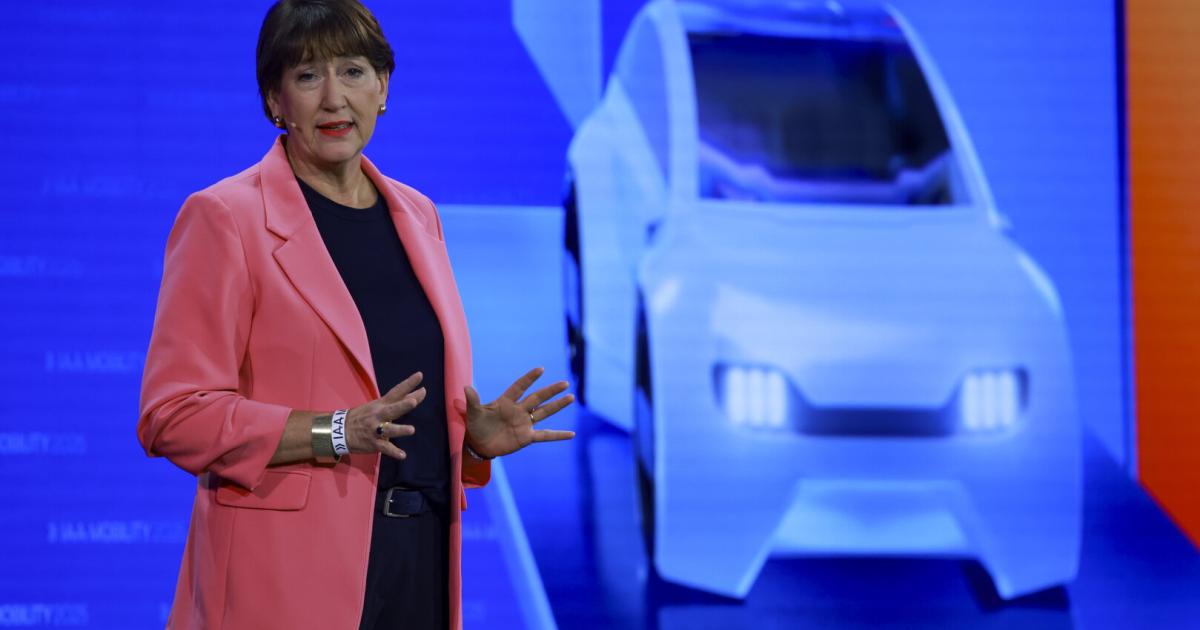
Hildegard Müller looks at a construction site from her Berlin office. “Perhaps symptomatic for the country, the auto industry and the transformation,” said the President of the Association of the German Automotive Industry (VDA) on Tuesday at an OECD webinar. She has led the powerful lobby association for six years – and has experienced one crisis after another: Covid, the Ukraine war, supply chain problems. In addition, there is the biggest upheaval in the industry in decades: the conversion to climate-neutral and digital mobility.
The VDA originally calculated that the switch from combustion engines to electric cars would cost 190,000 jobs between 2019 and 2035. Müller is now assuming 225,000 jobs because Germany is no longer competitive as a location. “This is not a management failure,” emphasized Müller. The transformation is changing job profiles. You have to be honest about the fact that not every job loss can be avoided. Because the cost backpack is getting heavier: energy prices, bureaucracy, additional wage costs. Collective agreements also need to be examined. In good times, it is right to let employees share in the success.
“But in the bad times the question may also be, can you work a little more?” said Müller. “Perhaps work two or three hours more a week and this can prevent a factory relocation.”
Geopolitical situation
At the same time, the lobbyist is demanding that plug-in hybrids be permitted beyond 2035. This could save around 50,000 jobs in Germany.
“No one is exiting as radically as Europe – neither India, nor China, nor the USA, nor Canada,” she argued. The question is whether one can allow more openness on the path to climate neutrality instead of just relying on bans.
The 2019 fleet limits were decided in a “completely different world” – before the Ukraine war, before the geopolitical upheavals and before the question of whether Europe would even be able to produce enough batteries itself by 2035.
Competitor China
“Are the instruments sometimes more important than the goal?” asked Müller. “I don’t want to see climate protection fail. And we will see it fail if we are too dogmatic.” The geopolitical situation is increasing the pressure. China, once a lucrative sales market, is now a competitor. In the first quarter, sales of all brands in China fell by 19 percent. At the same time, Beijing is acting strategically: currency devaluation, export restrictions, massive industrial support.
“1.4 billion people – the country wants its own economic development. That’s legitimate,” said Müller.
Europe must forge new alliances: with India, Africa and Latin America. “Europe needs to pay more attention to value chains, from raw materials to further processing,” she said. “Building resilience without isolating yourself – that is the challenge.”
Home – Estructura y función de los recursos digitales en el sector del juego en línea – The Stamp Stampede
17054
BrickLink About Me Pages – About Alonto33
7379
Discovering Popular Online Gaming Platforms: Reasons for Their Appeal – watch faces for Apple Watch, WearOS, Galaxy Watch, Pixel Watch, Huawei Watch, and more – Facer
GaryMHollar's Blog – Community – The Sims 3
"Lucky" by Allistair — Christian Song Lyrics | NewReleaseToday
Poser – 3D Rendering & Animation Software
Barbkerns
96987
Razvoj online casina i njihova privlačnost הפרופיל של — The Movie Database (TMDB)
Shikaka casino | PeakD
Naya
Chatting D7800 Shikaka Espa%F1.Html
Shikaka casino España
Shikaka casino España
Shikaka casino Hrvatska événement
Home.Php
The modern and interesting overview of the online platform Shikaka in 2026
Oportunidades modernas de entretenimiento en línea | MolecularCloud
2622975
Youtube Icon
root by fernandos
lianass on Tooter: 'Industrija online kockanja nastavlja se brzo razvijati, nudeći igračima sve više prilika za ugodan i siguran odmor.
Zanimljiva recenzija popularne zabave