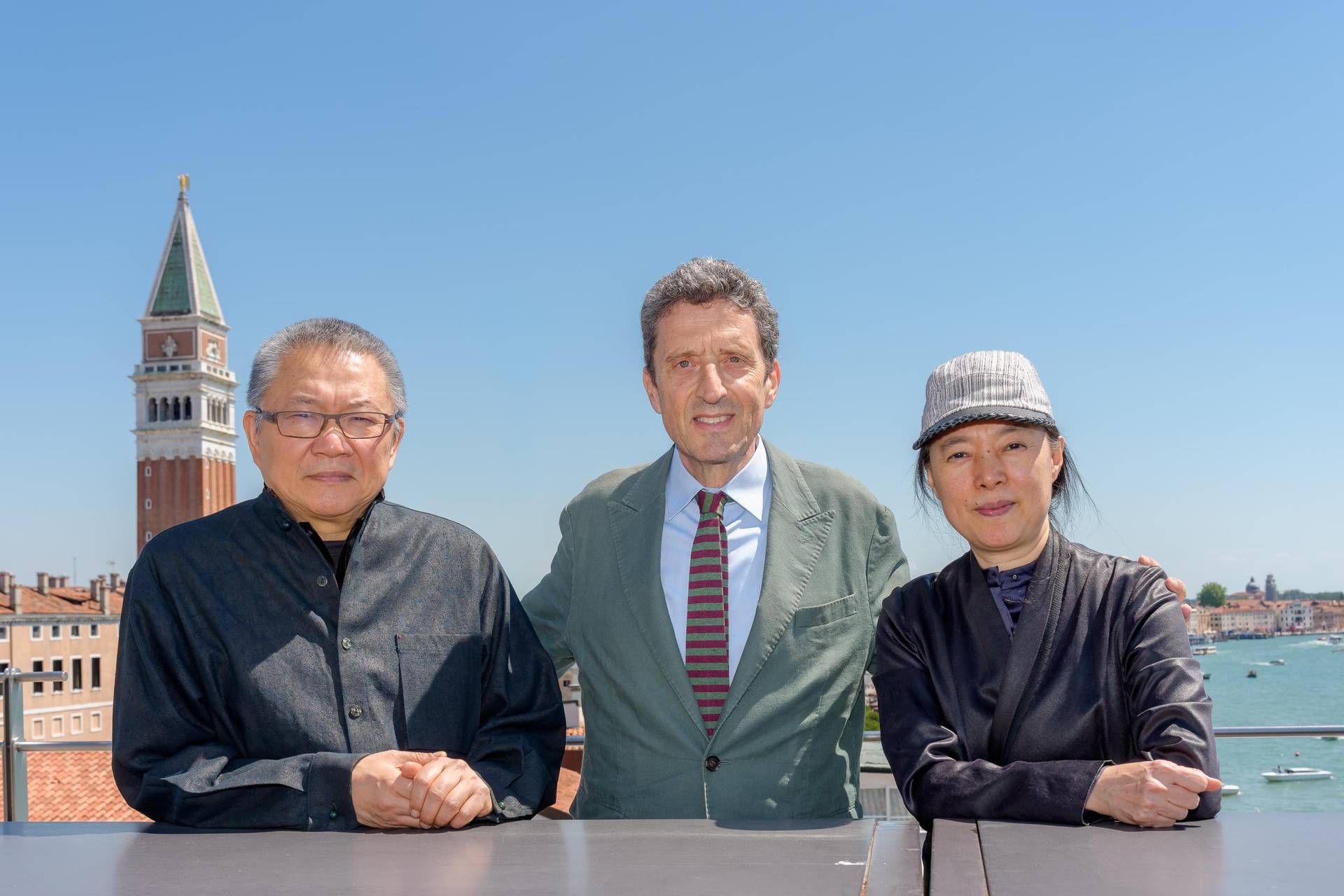
Architecture as a concrete practice, as an exercise in building that measures itself with materials, places and communities, rather than as an abstract language or device of representation. It is around this idea that “Do Architecture – The possibility of coexistence in real reality” revolves, the theme of the 20th International Architecture Exhibition of the Venice Biennale, scheduled from 8 May to 21 November 2027 (with pre-opening on 6 and 7 May), between the Gardens, the Arsenal and various spaces in the historic center of Venice. The announcement of the title “Making Architecture”, which took place today at Ca’ Giustinian, home of the Biennale, marks the start of the curatorial path entrusted to the Chinese architects Wang Shu and Lu Wenyu, who set their vision around a central question: how can architecture inhabit the contradictions of the present without reducing them, but rather transforming them into conditions of coexistence?
The theme develops, in fact, as a constellation of questions that cross some of the most evident fractures of the contemporary world. Climate change and the need for new construction models; the relationship between advanced technologies and local artisanal knowledge; the tension between memory and innovation; the conflict between urban growth and the fragility of rural territories. Issues that are not addressed as problems to be solved once and for all, but as permanent conditions of the project.
Wang Shu and Lu Wenyu, the first Chinese curators of the Biennale, insist on the need to bring architecture back to its original dimension: that of “doing”. “We believe that architecture is not just something to discuss, but above all something to do in person”, they say, defining the discipline as a “philosophy of doing” that deals directly with the material reality of places. From this perspective, designing does not just mean imagining forms, but entering into a relationship with what already exists: soils, building traditions, local energies, physical and cultural limits.
The title of the Biennale itself, “Do Architecture”, thus takes on a programmatic value: not a generic call to action, but a declaration of method. Making architecture means, for the curators, accepting that even apparently incompatible elements can find a form of coexistence within the same built space. It is in this friction that, according to their vision, the very possibility of the contemporary project is generated. Among the questions posed in the curatorial text, some central issues emerge: can territory and architecture coexist without one canceling the other? Is it possible to integrate natural materials and local knowledge into contemporary construction processes without reducing them to decorative elements? And again: can memory and innovation really coexist in a dialectical way, without one prevailing over the other?
Alongside this reflection is the position of the president of the Biennale, Pietrangelo Buttafuoco, who underlines how the work of the curators Wang Shu and Lu Wenyu brings “architecture back to its most concrete, physical and necessary dimension, that of building in direct relationship with the earth, with the materials, with the communities and with the reality of the places. Their thought reaffirms the value of ‘doing’ as a cultural, ethical and constructive act, eschewing spectacularisation and global standardisation. Through the recovery of materials, artisanal techniques and slow transformation processes, Wang Shu and Lu Wenyu propose an idea of architecture that incorporates the past as a living material of the present. A striking example of this is the University Campus of the China Academy of Art in Hangzhou, which they designed and experienced daily together with the students of the Architecture courses. And it is also the reason that persuaded me to entrust them with the direction of the 2027 Architecture Biennale: finding myself and moving within theirs. buildings was the most formidable of counter-evidence to the most convincing of theories”. The theme identified for the 2027 Architecture Biennale, “Do Architecture – The possibility of coexistence in real reality”, takes on for Buttafuoco “the meaning of an invitation to build possibilities of coexistence between nature and artifice, between innovation and memory, between contemporary project and local cultures. Their appointment as artistic directors of the Architecture sector recognizes in this discipline the ability to take root in the reality of the territories, and to transform them while protecting their complexity”. Buttafuoco then announced that the 2027 Architecture Biennale will go from bilingual (Italian and English) to trilingual with the addition of Chinese.
Wang Shu is the winner of the 2012 Pritzker Prize for Architecture and a member of the Académie d’Architecture of France since 2023. An architect and teacher, he co-founded the Amateur Architecture Studio in 1997, together with Lu Wenyu. In 2003 they established the Department of Architecture at the China Academy of Art, and in 2007 they established the School of Architecture, of which Wang Shu was the first dean.
https://imisslviv.com/prostitutka-4476/
https://imisslviv.com/prostitutka-4522/
https://imisslviv.com/prostitutka-4579/
https://imisslviv.com/prostitutka-4585/
https://imisslviv.com/prostitutka-4589/
https://imisslviv.com/prostitutka-4610/
https://imisslviv.com/prostitutka-4618/
https://imisslviv.com/prostitutka-4544/
https://imisslviv.com/prostitutka-4574/
https://imisslviv.com/prostitutka-4617/
https://imisslviv.com/prostitutka-4447/
https://imisslviv.com/prostitutka-4487/
https://imisslviv.com/prostitutka-4497/
https://imisslviv.com/prostitutka-4500/
https://imisslviv.com/prostitutka-4435/
https://imisslviv.com/prostitutka-4437/
https://imisslviv.com/prostitutka-4482/
https://imisslviv.com/prostitutka-4513/
https://imisslviv.com/prostitutka-4546/
https://imisslviv.com/prostitutka-4557/
https://imisslviv.com/prostitutka-4612/
https://imisslviv.com/prostitutka-4453/
https://imisslviv.com/prostitutka-4540/
https://imisslviv.com/prostitutka-4548/
https://imisslviv.com/prostitutka-4573/