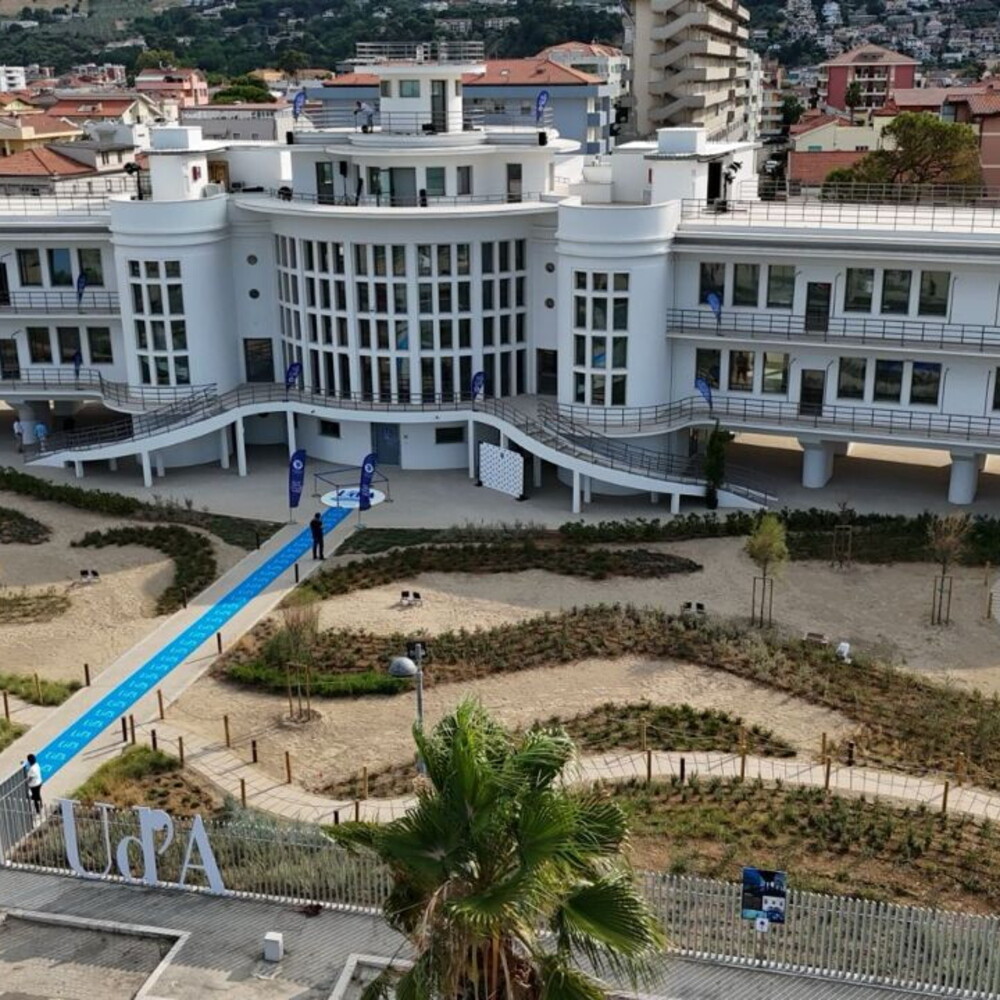
Forty years to design the future of a fascinating structure that comes from the past. It was a marine colony for children in the 1930s, it was named after Rosa Maltoni Mussolini, the teacher and mother of the Duce, it was then renamed Stella Maris and therefore experienced a long period of tarnishment, decline and pathetic abandonment. His fate seemed sealed, between abortive projects and a marked yet incomprehensible ideological aversion that wanted him to disappear for what he represented and not for what he was and wanted to continue to be. Finally, it was the “Gabriele d’Annunzio” University of Chieti-Pescara, which transformed the former colony into a top-level cultural center and gave a safe haven to one of the most evocative buildings of the twenty years.
The homage to the seaplanes of the heroes of the air by Italo Balbo
The architectural lines, in fact, openly recall the Savoia Marchetti S55 seaplanes, one of the symbols of the Italian aeronautics and protagonists of the amazing cruises of Carlo De Pinedo, Carlo Del Prete and Vitale Zacchetti, and above all of the formation flights of 1933 from Orbetello to Chicago for the tenth anniversary air cruise (of fascism, and hence the name of the X version). There is only one example of this seaplane, currently preserved in a museum in Sao Paulo, Brazil. But those futurist forms that exalted the world and brought Italo Balbo’s popularity and fame to its peak, inspired the architects so that the stone would preserve the lines and pass on the exploits of the Blue Army.
In front of the sea, hospitality for two hundred children in the city of speed
It was 1937 when the project began on a symbol that was to be eternalized by the very shape of a public housing building. It was the architect Francesco Leoni and the engineer Carlo Liguori who gave stylistic inspiration to the marine colony of the federation of the combat fascists of Rieti, in the province of a city like Pescara which had hosted one of the first aeronautical events in history (1910), where the first helicopter in history had taken off with the signature of the engineer Corradino D’Ascanio (1925) and which hosted one of the most prestigious and demanding car races like the Coppa Acerbo, the first edition of which was won in 1924 by Enzo Ferrari. And then Pescara was the city of Gabriele d’Annunzio, the hero of the flight over Vienna and of the Hoax of Buccari, a lover of airplanes (he had boarded for the first time in 1909), engines and daring. The idea for the structure dates back to 1935, with the request of the Federation of the National Fascist Party of Rieti for a space to create a marine colony suitable for hosting at least 200 children. The Municipality of Montesilvano then donated 12,000 m2 facing the sea to the Pnf Federation of Pescara which in turn sold it free of charge to the Rieti Federation. The works had started late but the inauguration ceremony took place on 28 November 1938, complete with a blessing. Even today, the writing “The Duce builds the Navy of the Federation of Combat Fasci for the health of his children” is clearly visible on a column, while the fasces in bas-relief was chiselled after the war.
Shade during the day, moonlight at night, and all the services for the marine colony
The building has been defined as «one of the most successful metaphors created by the architecture of the period. The shape of the plane appears very evident in plan view, but offers a less suggestive image from above” (Raffaele Giannantonio, The construction of the regime. Urban planning, architecture and politics in the Abruzzo of fascism, Rocco Carabba, Lanciano 2006). At the time it was praised that the parts of the building represented the aircraft, the canvas wings had become the dormitories, the central part housing the engine had been used as a refectory, the nacelle as a changing room and corridors and the rear part, the tail rudder, as an infirmary and services. The dormitories were capable of hosting more than 200 children, with toilets and washrooms well separated from the places where they rested, and accommodation for the instructor and supervisory staff. On the ground floor there were the management offices and a spiral staircase led to the commander’s quarters and the command turret. There was no lack of either a gym for the care of the body or a chapel for that of the soul, much less a refectory, warehouses, changing rooms and medical office. It was all designed to have shade during the day and moonlight at night.
The decline, abandonment and rebirth as a center of the University of Chieti-Pescara
After about forty years of failed initiatives, partial restorations and adventurous and unachievable (or at least unrealized) intended uses, the former Stella Maris with the passage from the Province of Pescara to the “Gabriele d’Annunzio” University has been affected by in-depth works just concluded to make it a center for the study of climate and sustainability and a center for supercomputing and big data collection. The rector Liborio Stuppia, in the inauguration ceremony, illustrated the guidelines that will be followed by the university in the 29 years of the agreement, and which will make The Airplane, as everyone calls it, take off towards the future and the challenge of knowledge. Fascinating like few university buildings, certainly unique in its seductive shape, slim and sharp despite the muscularity of the reinforced concrete.