The sweet name, Marcinelle, has become acrid in the evocation of a tragedy that in August seventy years ago, from the darkness of the mine brought to light all the contradictions of a job that did not ennoble man but snatched his life away. In Belgium’s Bois du Cazier, on 8 August 1956, the drama of 262 men blackened by that coal who searched ever deeper, half of whom, 136, were Italian, and half of them from Abruzzo, took place in the silence of the bowels of the earth at almost a kilometer depth and in the frenetic agitation of the surface; and then 95 Belgians, 8 Poles, 6 Greeks, 5 Germans, 3 Hungarians, 3 Algerians, 2 French, 2 Soviets, an Englishman and a Dutchman. Eleven nations united by the pain of a damned accident in a structure whose danger was known. But Europe needed coal to relaunch its industry, Belgium to recover economic competitiveness, and Italy to recover and give work to the many unemployed by sending them abroad.
Two hundred kilos of coal per day for each worker
The agreement between Belgium and Italy was signed in 1946 by prime ministers Achille van Acker and Alcide De Gasperi. It provided for the transfer at a subsidized price of two hundred kilos of coal per day for each Italian worker sent to the Belgian mines, in installments, up to 50,000. The manpower recruitment notices were printed on pink posters so that they were immediately visible, and reported all the favorable conditions of pay, social assistance, holidays, hospitality, early pensions, free travel. There was everything to attract those desperately looking for a job in the starving post-war Italy, and thousands left from Abruzzi, Veneto, Neapolitan, Puglia, Sicily. Many had started from the Pescara area of Manoppello, Lettomanoppello and Turrivalignani, on the slopes of the Majella, from a region devastated by the war, split in two by the Gustav Line for nine months between 1943 and 1944 and where the scorched earth tactic had been applied. What the pink posters didn’t say was discovered upon arrival: dormitories in barracks used for German prisoners of war in the First World War, with temperatures of -10° in winter and 30° in summer, exhausting and dangerous work shifts, precarious safety standards, hostility from the local population who put up signs prohibiting entry into the bars, cafés and pubs “aux chiens et aux italiens”: dogs and macaronì. But the hunger was great at home, and bread had to be looked for elsewhere. And the Italian industry, plagued by the fury of war and the indispensable drive of reconstruction, was hungry for coal, and therefore for energy.
The tragedy at the morning shift change
A trolley that wasn’t supposed to move, perhaps due to an order that wasn’t supposed to be given and which in any case wasn’t well understood by an Italian miner who didn’t yet understand French well, a high pressure oil cable severed when it came out of the tracks, the friction sparks and then the flames of hell and the acrid smoke that spread everywhere. It was just after 8am on 8 August 1956. Commissions of inquiry and trials will try to give an answer that through the documents could soothe consciences and soothe the pain, seeking responsibility that could not fall on the worker Antonio Iannetta nor just on the chief engineer Adolphe Calicis who in the end received six months of imprisonment, the only one definitively convicted for that tragedy.
Everything went wrong, at the Bois du Cazier, 975 meters below the surface. The system was old, the safety measures and maintenance were inadequate and human error took its toll. From January 1947 to December 1955, 1,164 miners had died in the Belgian mines. The data had been provided in February 1956 by the Belgian Minister for Economic Affairs, Jean Rey: a third of those victims, 435, were Italians, and another twenty would have been added to the statistics until 7 August. On the 8th, 274 of them were trapped underground, where they earned their living in unspeakable conditions, where if you escaped an accident that was always around the corner you would have silicosis in your lungs for your whole life. From above, the alarm sounded at 8.48, one could only imagine what was happening down there. Those who had just come off shift immediately worked with the rescue teams, lowering themselves into the black gut to save their trapped comrades. Other miners rushed in immediately, while the Belgian authorities tried to coordinate operations in the chaos.
Twelve were rescued from death. Then, on August 23, just two words: “All corpses”
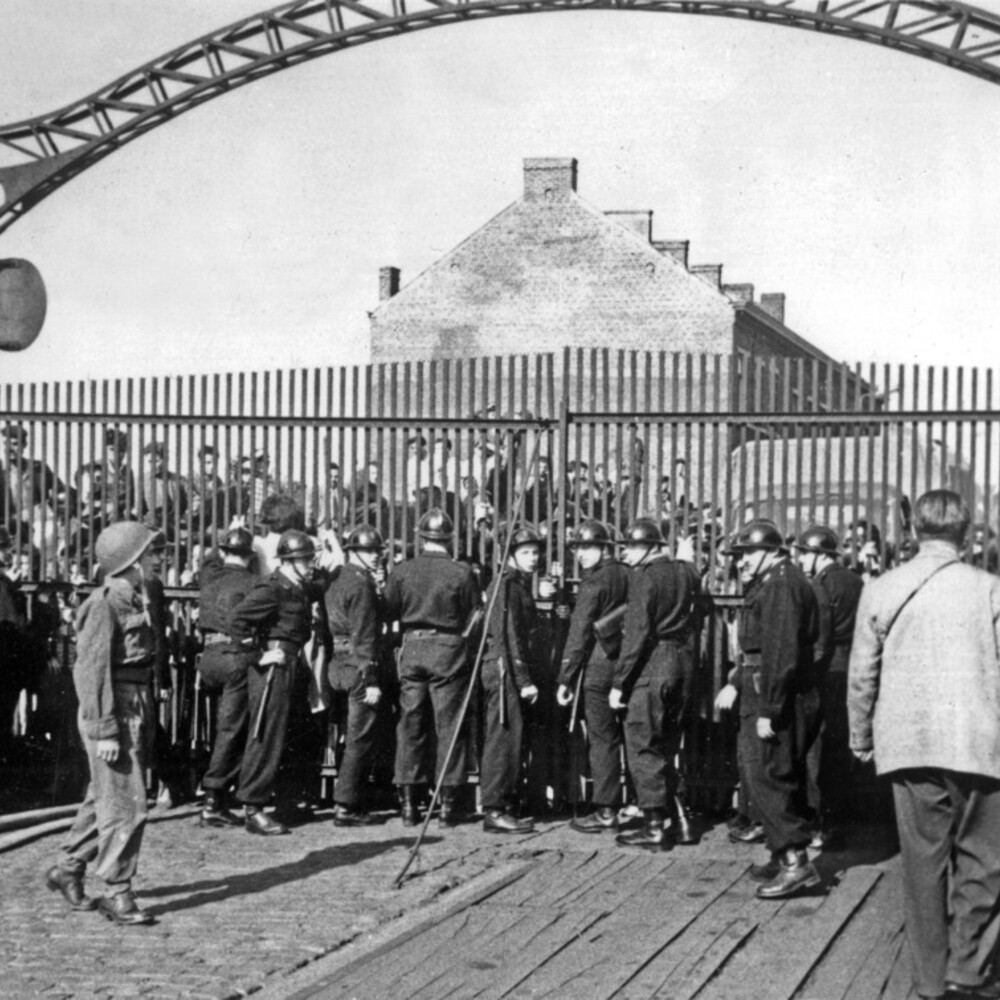
Outside the closed gates dominated by the now disturbing silhouette of the castles, a crowd of family members, relatives, friends and acquaintances crowded together. The designer Walter Molino will provide a representation of it that has become iconic, with the cover of the Domenica del Corriere on 26 August. Three days earlier, hopes of being able to save even one more life had been definitively dashed. “All corpses,” said the rescue team who came to the surface for the last time. Twelve, out of 274, had been saved from death by intoxication from carbon monoxide, smoking, and the end of oxygen after desperately looking for a way out that wasn’t there. Silvio Di Luzio, a former freedom fighter in the Maiella Brigade, brought out three, the Abruzzo volunteers who had fought as part of General Anders’s Polish II Corps in the Marche, up to Bologna where they had entered first at dawn on 21 April 1945, and then up to Asiago. In 1958 he will be publicly decorated by the King of Belgium, Baudouin, and he will be amazed by that recognition, because, he said, he had done what anyone else would have done to save a human life. The President of the Italian Republic Carlo Azeglio Ciampi will remember his gesture in 2002, decorating him in turn, three years before the death of the patriot-hero.
The price of the disaster, legacy and memory
Partly in French and partly in Abruzzo, that story became “the catastrophe” for everyone. What happened next falls within the depths of a bureaucracy darker and more unfathomable than the blind tunnels of the Bois du Cazier mines. The insurance and disputes were triggered, the compensation was not what was due, an additional monthly payment was paid, the papers and stamped papers piled up. The bodies of the Abruzzo miners returned to their land of origin only at the end of November 1956. On the 27th in Pescara, in the cathedral of San Cetteo commissioned by Gabriele d’Annunzio, the solemn funeral of the miners from Marcinelle, whose bodies had only arrived the evening before, were celebrated. That funeral was filmed with a rare color film, which has now become a historical document. The “catastrophe” became a moment of profound reflection on the risks of work and the need for stringent safety and prevention measures. It served to break down the xenophobic barriers that divided Belgians from immigrant workers, a third of whom were Italian. It indicated a new civil conscience. The remittances of those who responded to the call on the pink poster contributed to reviving the fragile economies in the central-southern countries. Those sacrifices were the price to pay for well-being. The new generations will redeem that past of suffering and sweat, both by returning home and by remaining in the country of choice. Elio Di Rupo, prime minister of Belgium, is the nephew of one of Marcinelle’s “black faces”. The last of the Abruzzo people, Nunzio Mancini, died at the age of 96 on 29 June 2026: in Manoppello, which with its 23 victims had been defined in a 1956 Corriere della Sera report as the town of widows and orphans. The Bois du Cazier was definitively closed in 1967 and, having eliminated the risk that the site could be converted into a shopping centre, in 2012 it became a UNESCO heritage site and an industrial museum of the memory of work and its victims. As for the payment of 200 kilos of coal for each man, it was almost never respected. That 1946 agreement was just a question of numbers: of coal and men.