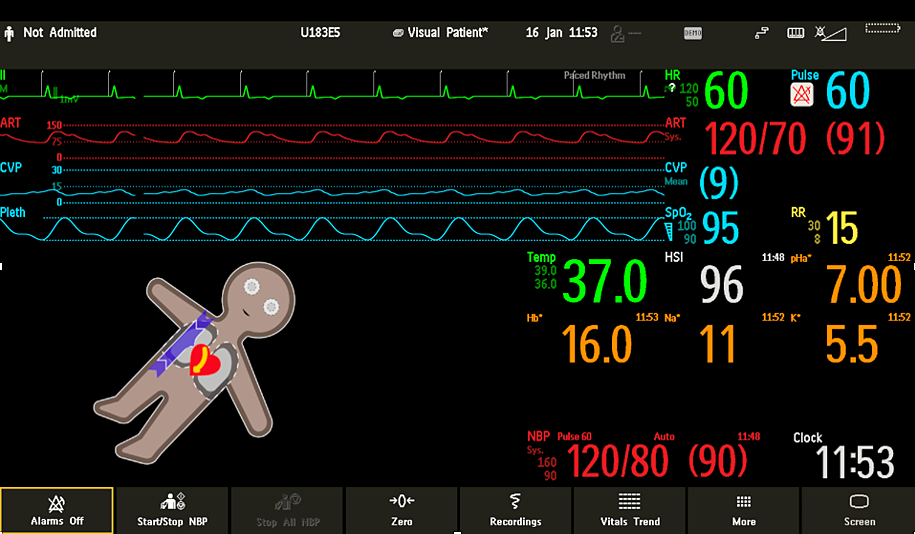
The “patient avatar” model integrates artificial intelligence (AI), helping intensive care doctors (ICU) read the patient’s condition instantly and make decisions in just a few seconds, thereby improving treatment efficiency for seriously ill patients.
“Patient monitoring is no longer simply observing indicators on a screen,” Professor Aurel K. Qian, member of the Advisory Board of the Healthcare Information and Management Systems Society (HIMSS) Asia-Pacific region, commented at the event. Innovation Summit recently organized by Philips.
In fact, health systems in many Asian countries are facing increasing pressure as demand for health care increases rapidly, while medical resources have not kept up. According to the annual Future Health Index report, up to 66% of patients have to wait a long time to access a specialist, while 76% of medical staff say they often lose valuable time due to fragmented, incomplete or difficult-to-access medical data.
This situation is even more serious when it is predicted that there will be a global shortage of more than 11 million health workers by 2030, of which Southeast Asia accounts for about a quarter. Therefore, the healthcare industry is gradually shifting to a care model based on real-time data and a comprehensive view of each patient, helping doctors access information that is accurate, intuitive, easy to interpret and supports more effective decision-making. Thanks to that, the medical team can reduce system processing time and focus more on the patient, according to Professor Aurel K. Qian.
The Patient Avatar tool visualizes data to help medical staff quickly assess a patient’s condition. Image: Truc Nguyen
In this context, experts have proposed a new solution based on the Enterprise Command and Care Coordination Center open platform, allowing connection and synchronization of patient data between bedside devices, operations centers and hospital technology systems. Thanks to the ability to connect data, doctors and nurses can continuously monitor the status of ICU patients in real time, instead of depending on discrete systems as before.
The heart of the solution is the application of AI to analyze vital data to detect early signs of deterioration such as arrhythmia or cardiovascular events. The system prioritizes alerts by severity, helping to reduce information noise and support medical teams to focus on cases that require urgent intervention.
Combined with a wireless monitoring device, the solution also allows remote monitoring of ICU patients, while maintaining continuous monitoring even when the patient moves into the post-treatment phase. In addition, mobile devices help doctors access patient information anytime, anywhere on a unified interface.
One thing worth noting is the patient data visualization tool through the Patient Avatar model – visually displaying complex indicators in an easy-to-understand image, helping medical staff quickly assess the patient’s condition in high-pressure environments such as the ICU. Unlike traditional tracking based on a series of numbers and charts, this tool converts all complex survival data into visual images. Indicators such as heart rate, respiration, blood pressure or blood oxygen saturation level are displayed right on a body model, helping doctors quickly identify abnormal conditions in just a few seconds.
“This approach is especially important in the ICU environment, where each decision is under great time pressure. Instead of having to synthesize data from many individual monitoring screens, medical staff can grasp the ‘overall picture’ of the patient immediately, thereby shortening response time when an event occurs,” said a Philips representative.
Experts say that AI plays a core role behind this solution. Algorithms continuously analyze data in real time, detecting unusual trends and predicting risk before symptoms become apparent. When combined with the Patient Avatar tool, these warnings are not only displayed as technical specifications but also visualized, helping doctors quickly grasp the situation and make timely decisions.
Ms. Stephanie Sievers, CEO of Philips Asia-Pacific region, shared at the event. Image: Truc Nguyen
According to information provided by Philips, medical facilities implementing this solution have recorded many significant improvements: up to 40% reduction in unnecessary alerts in the ICU, 69% shortening of ICU treatment time and up to 86% reduction in cardiac arrest cases. These results demonstrate the potential of AI to assist physicians in early detection of risk and optimize clinical intervention.
“Patient monitoring solutions are built on decades of innovation, supporting the care of millions of patients each year. We partner with hospitals to help medical teams act sooner and respond more effectively at scale,” said Stephanie Sievers, CEO of Philips Asia-Pacific.
Philips representative also said that the long-term orientation is to build a predictive, connected and seamless solution, helping medical staff not only monitor but also proactively prevent complications, thereby improving treatment effectiveness and patient safety. In the context that the Asian region is facing the pressure of shortage of medical human resources, smart monitoring solutions are expected to help optimize resources, reduce the load on the nursing team at the hospital bed, and ensure that ICU patients are always closely and continuously monitored.
https://www.workplacepeaceinstitute.com/group/mindful-leadership/discussion/5bd81ab1-c07a-4e6c-9204-b34f5fcdeadf
https://www.hbshaveice.com/group/los-angeles-county-members/discussion/906240d7-49a4-4d39-8318-55ef89e81c2d
https://www.allin4elphin.org/group/mysite-200-group/discussion/86abf2da-2e4d-4a10-a503-2c91073c35f6
https://www.coconutpartnership.org/group/groupe-de-sustainablecoconutpa/discussion/68cc5c2d-890f-4ed8-b504-94eeb7e8c4b0
https://www.harmonpark.org/group/first-class-mentor/discussion/f5539b68-4f7b-4c9f-a4db-9e403079dc32
https://www.tabernacleseattle.net/group/working-mothers/discussion/02945eef-9136-4b5a-a1f3-d906eba5cc77
https://www.thaitamarindhouse.com/group/thai-tamarind-fans/discussion/38288eef-8edb-4bc4-b715-3a74535c141d
https://micro.blog/tejay
https://www.valleycrystalshop.com/group/valley-crystal-community-share-shine/discussion/57877c74-daac-4335-bbd0-2dec7fb41112
https://www.myfitnesssuites.com/group/a-winter-cut-crew/discussion/caea6f8e-f4b8-45c4-9154-8e49ea5d43fb
https://www.tastealanya.com/group/mysite-231-group/discussion/ad8ffd2a-9b1f-4af4-b1de-51c1bc6eb693
https://www.theeducationalwarehouse.com/group/tew-group/discussion/02e586ae-f785-4f5d-81c4-fe5898e49c08
https://www.paahec.org/group/remote-learning-support/discussion/38e095a9-a82d-4195-852d-e0e22b77d006
https://www.ppkortrijk.com/group/blue-stone-island-trouser/discussion/6381761a-c486-4d9f-b0f5-a37f4249e55b
https://www.engagedu.co.uk/group/engagedu-group/discussion/c75c1287-a35d-4c42-a8b9-296aaef63d94
https://www.kamanabranford.com/group/kamana-branford-group/discussion/7ae61233-e091-466e-bd74-446d67aa3850
https://www.inmymindpsychology.com/group/mental-health-servic-group/discussion/b0441f86-5838-4b68-90f6-5fb74fbda929
https://www.hopealongtheway.net/group/lets-talk-strength/discussion/9d80cdea-0275-4979-89de-934d88635576
https://www.fmasu.com/group/the-electric-film-series-group/discussion/8e709cdd-68fd-4d5a-9f92-033ffcbd6790
https://www.bstrongandcourageous.com/group/b-strong-and-courageous-soccer-camp-2025-group/discussion/67c0756a-a473-4337-8bcf-a668bd87a4c1
https://www.dhanashreebhatkal.com/group/money-group/discussion/c8ef75f5-e4d3-405a-ad3e-e8e56561966e
https://www.divinemarga.com/group/health-longevity/discussion/853a9fd7-9163-4cc1-b829-8b51b18a21b2
https://wemixplay.com/community/rom/10/611
https://www.deism.com/group/united-states-world-union-of-deists/discussion/60fbf971-7fd8-42a2-9ec5-7443baf16418
https://www.cherisebryantfitness.com/group/mysite-200-group/discussion/22f31bca-2379-4a0b-9d28-9772aeed8db9