NASA released a timelapse video from the right navigation camera of the Curiosity robot, recording the journey on the rough Martian surface in 2020-2026.
This camera is not designed to produce beautiful footage. It often faces backwards, helping experts identify interesting rocks and terrain features as Curiosity passes by. However, the research team stitched together thousands of everyday photos, creating continuous footage of movement and environmental changes.
NASA said: “The Curiosity team is using this timelapse video to observe sand grains shifting on the robot’s body. Distinguishing between sand disturbed by each move and by wind blowing can provide new information about seasonal changes in the atmosphere.”
Footage of the Curiosity robot moving on Mars in the period 2020-2026. Video: NASA
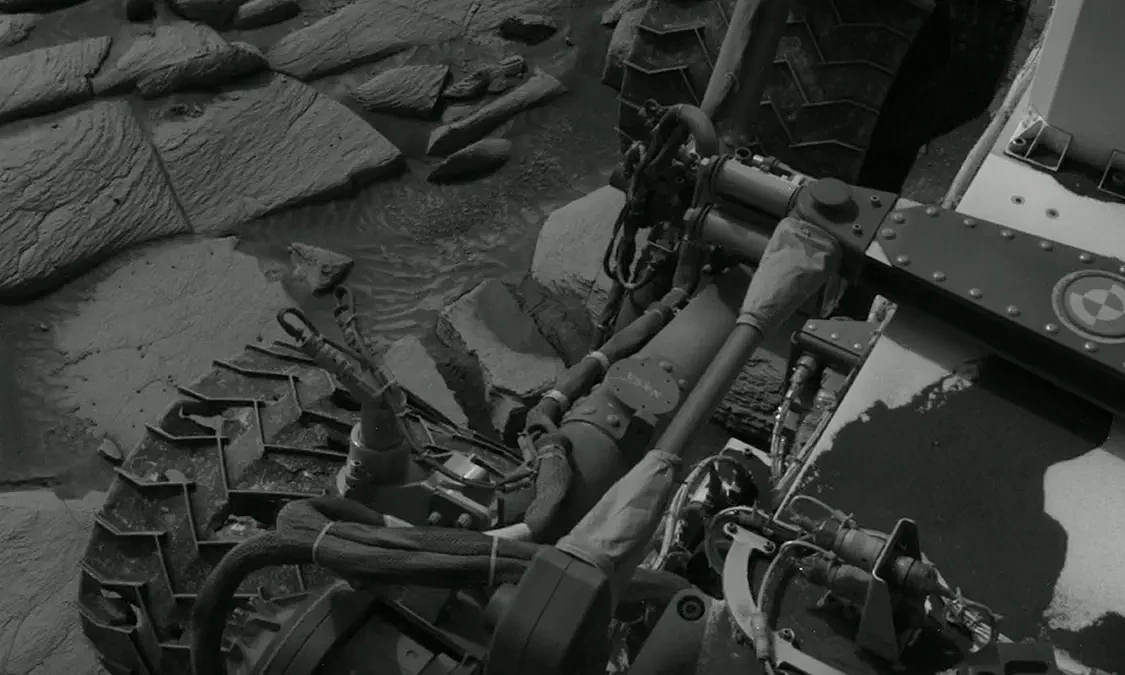
Theo Spacethe new video also shows the difficulties in Mars exploration. Curiosity’s six wheels, each about 50 cm in diameter, are designed to withstand rough and sharp terrain. However, the surface of Mars proved to be harsher than expected. Not long after the robot landed in Gale Crater in 2012, engineers began to see damage to the thin aluminum wheels, punctures and tears caused by sharp rocks.
Images released by NASA over time show the increasing level of damage. However, Curiosity is still completely mobile, demonstrating the robot’s durable design and the engineering team’s reasonable control strategy. The experience gained also helped improve the design of future Mars exploration robots, including the Perseverance robot with reinforced wheels to better cope with complex terrain.
Damaged wheels of the Curiosity robot in March 2026. Image: NASA
This week, NASA also announced that it had resolved the problem of Curiosity’s drill bit getting stuck in rock for the first time after more than 13 years of operation. Previously, on April 25, Curiosity drilled to sample a rock called Atacama, estimated to have a bottom diameter of about 46 cm, a thickness of 15 cm and a weight of 13 kg. When the robot retracts its arm, the entire rock is lifted off the ground, hanging over the drill bit. After several failed attempts, experts tilted the drill more, combined with rotation and vibration, causing the rock to fall out.
Curiosity, as large as a car, landed in the Gale crater in August 2012 with the mission of determining whether this area once supported microbial life. The robot then discovered that, in ancient times, Gale contained a system of rivers and lakes potentially suitable for life.
The robot then continued to study the rock layers as it moved, looking for clues about the transition of ancient Mars from a relatively warm and humid planet to the cold, barren place it is today. Science Alert said that during its operation, the robot overcame many problems such as the impact drilling mechanism experiencing a short circuit, the brakes being hindered due to debris, the drill jamming, and punctured wheels.