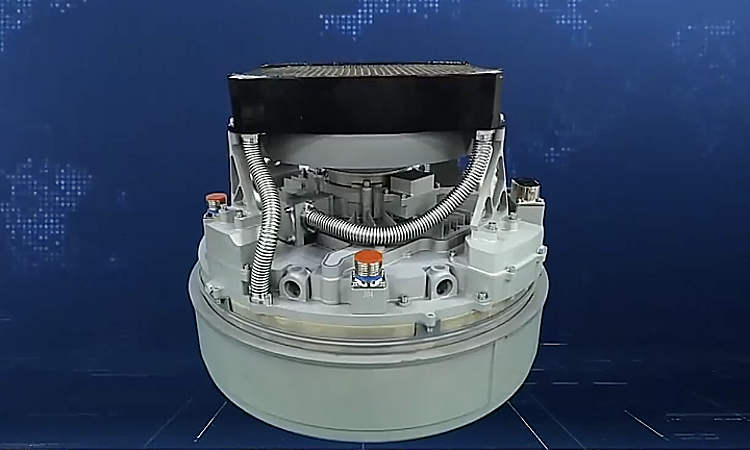
AEE25, an engine for electric vertical take-off and landing (eVTOL) aircraft, is light in weight, helping the aircraft carry more passengers or cargo.
The AEE25 aviation electric motor was delivered in Wuxi, Jiangsu province, eastern China earlier this month, scheduled to be installed on eVTOL E20 of TCab Tech company. This is the first engine exclusively for electric vertical take-off and landing (eVTOL) aircraft developed by China.
Theo Bastille PostAEE25 is manufactured by the Aerospace Engine Control System Institute (ACSI) of China Aerospace Engine Corporation (AECC). This motor converts electricity from the battery into lift and thrust for the propeller system. According to AECC, it achieves a torque density of 40 Newton-meters (Nm) per kilogram, the highest among 200 kW class aviation electric motors in China.
Simulation of the AEE25 aviation electric motor. Image: CMG
Zhang Yu, AEE25 project team leader, commented that this engine is suitable for common eVTOL models weighing 2-3 tons and carrying 4-6 passengers. He told Science and Technology Daily: “Higher torque density means lighter engines while maintaining the same power levels, allowing aircraft designers to allocate more weight to passengers, cargo or additional systems.”
Mr. Zhang noted that under the same power and weight conditions, the new engine model can generate greater torque than equivalent domestic products, helping the propeller create stronger lift and thrust. The engine’s torque density is expected to increase to 44 Nm per kg in the future.
Liu Guoping, deputy director of ACSI, said the AEE25 is highly integrated, can operate immediately after being installed with the propeller, connected to the power source and control system, helping to simplify the aircraft design process. “The motor is safe enough, every motor is designed in dual form and every controller has two channels. In case of an error at an odd point, the output power is still guaranteed,” Mr. Liu added.
Theo CGTNin recent years, ACSI has focused on electric motor and control technology for aerospace applications. The institute has established a department specializing in electric propulsion and accelerated the technology’s commercialization process. Some of the institute’s aviation electric engines have made important progress and can be put into mass production.
TCab Tech’s eVTOL E20 aircraft displayed at the 8th China International Import Expo in Shanghai on November 7, 2025. Photo: VCG
According to Huang Yongwei, founder and CEO of TCab Tech, cooperation with AECC not only helps overcome major technological bottlenecks, but also creates an effective research and development model, supporting the localization and development of China’s vertical take-off and landing electric aircraft.
Liu said ACSI will continue to promote technology research and technical validation to meet the growing demand for electric aircraft, next-generation propulsion and low-range economy applications. “We will provide lighter, more efficient and more reliable aviation electric motors for emerging aircraft types such as eVTOL,” he emphasized.
Xinhua said that China’s low-end economy is developing rapidly. According to the Civil Aviation Administration of China, this market is estimated to reach a value of 1.5 trillion yuan (210 billion USD) in 2025 and is expected to exceed 3.5 trillion yuan (492 billion USD) in 2035.
In recent years, China has made many strides in eVTOL, which plays an important role in the low-end economy. In February, the eVTOL model of China Aerospace Science and Technology Corporation (CASC) made its first test flight at Yongchuan Da’an Airport, Chongqing. The vehicle consists of a flying module and a ground-based module. In the test, the flight module carried two passengers at a maximum speed of 150 km/h at an altitude of less than 3,000 m, while the ground module had an operating range of more than 300 km.
Modular vertical take-off and landing aircraft of China Aerospace Science and Technology Corporation (CASC). Image:LAIB
Last November, AutoFlight, a Chinese eVTOL manufacturer, launched a mobile heliport developed by the company. This is a mobile landing pad on the water, with energy storage and solar power equipment, ensuring low carbon emissions. The landing pad can support two-ton passenger and cargo eVTOL, or industrial type with a flight range of 500 km, serving offshore energy exploitation and maritime rescue activities.
August 2025, 2000CG CarryAll, a Chinese-developed eVTOL model, completed its first offshore delivery. It took off from a land launch site in Shenzhen, carrying cargo such as fresh fruit and emergency medical equipment, landing on an oil rig 150 km offshore after 58 minutes of flying over water. The aircraft runs entirely on electricity, has a maximum takeoff weight of two tons, a carrying capacity of 400 kg, a maximum cruise speed of 200 km/h and a flight range of 200 km.