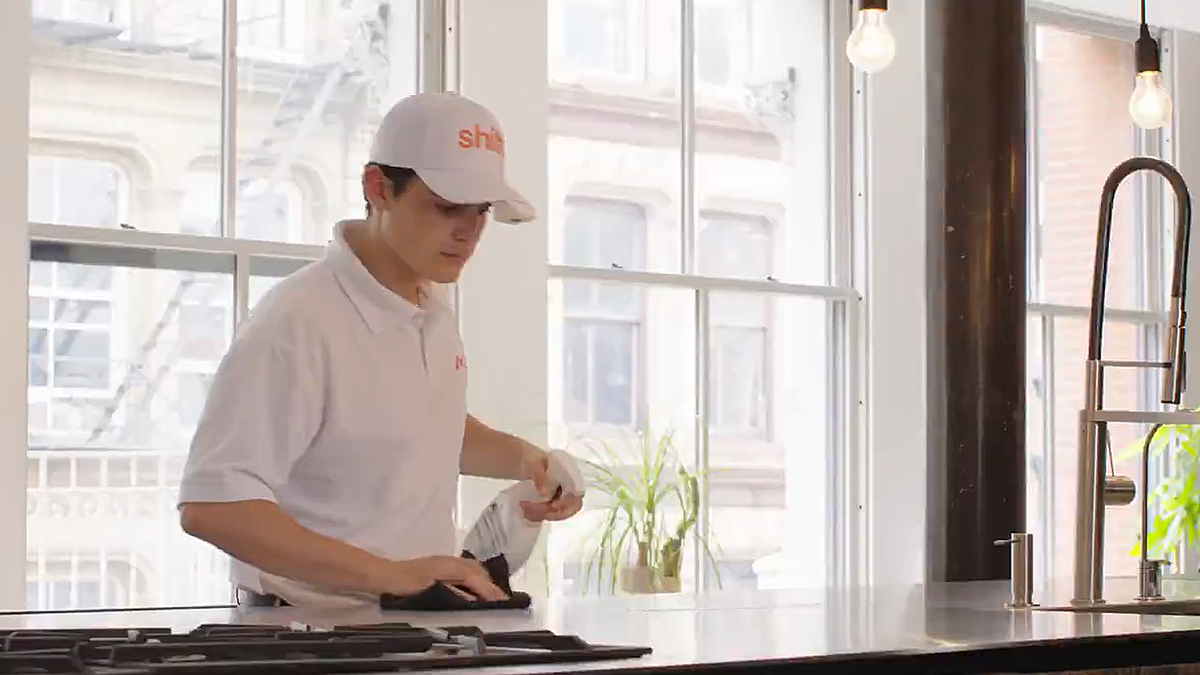
Startup Shift Robotics offers free house cleaning services in exchange for employees recording their work to get AI and robot training data.
In New York, where almost everything costs money, startup Shift Robotics offers a house cleaning service for 0 VND. However, the homeowner needs to allow the cleaning staff to wear a camera on their head to record the process of washing dishes, cleaning the floor or folding clothes. These images then become training data for AI labs and robotics companies.
The video introducing the Shift service posted on social networks X months ago currently attracts 8.5 million views. The first 250 seats were booked out almost immediately. “Thousands of people trying to book appointments,” Harry Kilberg, Shift’s US director, told Business Insider.
Theo BBCamong Shift’s employees are young people who have just graduated from college and are looking for work. The demand for free cleaning in New York is very high and they have to clean about 5 apartments a day, 5 days a week. The only difference between them and regular cleaners is that they have a camera mounted on their helmet, connected to their phone.
The goal of the program is to perform tasks that require manual dexterity, thereby training the robot to use its hands fluently. Therefore, staff also especially focus on hand operations when cleaning.
Free house cleaning service to get AI training data. Video: Shift
Shift is the consumer-facing brand of Micro AGI, a laboratory founded in Munich (Germany) last year. Micro AGI is working on artificial general intelligence (AGI) for machines that can operate in the real world. The lab was founded by Bercan Kilic and Yoan Iliev, two former Formula 1 aerodynamics engineers, and Anton Poletaev, a former researcher at the Alan Turing Institute.
According to Kilberg, Shift operates in 15 countries with 14,000 people collecting real-world data. He said the company helps solve one of the big problems for those wanting to move AI from chatbots to robots. While large language models are trained on vast amounts of text and images on the Internet, robots do not have a similar corpus. As a result, companies in the industry are trying to build on it by paying workers to document the work that robots can perform in the future.
Kilic further explained that current AI models like ChatGPT can create sentences based on pre-written text online, but each kitchen, living room or utensil is different. Therefore, robots need to be trained to adapt to many types of spaces and objects.
“In the real world, every object is different, the light also changes, nothing stays the same after a few hours. The robot needs to learn to coordinate its hands and camera with the surrounding environment,” he said, adding that the biggest difficulty is that the cleaning staff needs to collect tons of data. He affirmed that the goal of the activity is to “promote the progress of humanity”.
Theo Tom’s Guidea messy and dusty apartment is highly appreciated by Shift. The company’s website notes that “difficult cleaning environments can be especially helpful,” but also notes that employees “may decline any task they feel uncomfortable with.”
Shift’s business relies on selling data collected from people’s homes to robotics and AI companies for training purposes. To anonymize the data, faces and some content in the video are blurred, and no sound is recorded. Additionally, the company also uses the data for internal research.
New York is just the beginning. Shift plans to expand the model to more areas and add free or subsidized services beyond cleaning such as cooking and plumbing repairs.
Pronto employees clean a house in New Delhi (India) on March 23, 2026. Image: Reuters
Shift is just one of many names joining the burgeoning “realistic data market”. Their goal is to close the “100,000-year data gap” – a concept coined by researcher Ken Goldberg from the University of California Berkeley, who argues that robots lag far behind chatbots because of a lack of training data from the physical world.
Theo The Verge, Silicon Valley startup Human Archive plans to cooperate with home service companies like Pronto (India) to encourage workers to use camera helmets to record their work process. Many companies that have provided data for the chatbot boom such as Scale AI, Turing, and micro1 are also moving into this market.
The more services Shift provides, the richer and more useful the data obtained. The startup also pays attention to geographic diversity. According to Kilberg, they operate in places where few data companies are interested, such as Bulgaria, Georgia, and South Africa. He said that Shift’s model is especially popular in Türkiye.
However, the new service also raises many privacy concerns. Experts warn people to be cautious when providing personal data, especially about their home, in exchange for free services.
“You may initially receive money or services, but shared data always comes back to your detriment. Even if you trust the business collecting the data, there’s still a chance they share that information with the government or other companies,” Rory Mir, director of open access and technology community engagement at the Electronic Frontier Foundation, told BBC.
Calli Schroeder, director of the AI and human rights program at the Electronic Privacy Information Center (EPIC), notes technology being developed based on collected data could put cleaners out of work in the future. Schroeder said the free house cleaning benefit could be a fraction of the money made from selling the data. “I think people are underestimating the amount of sensitive information that home recordings capture,” she warns.