As one of the “Six Little Dragons of Hangzhou”, BrainCo develops non-invasive brain-computer interface (BCI) technology and devices.
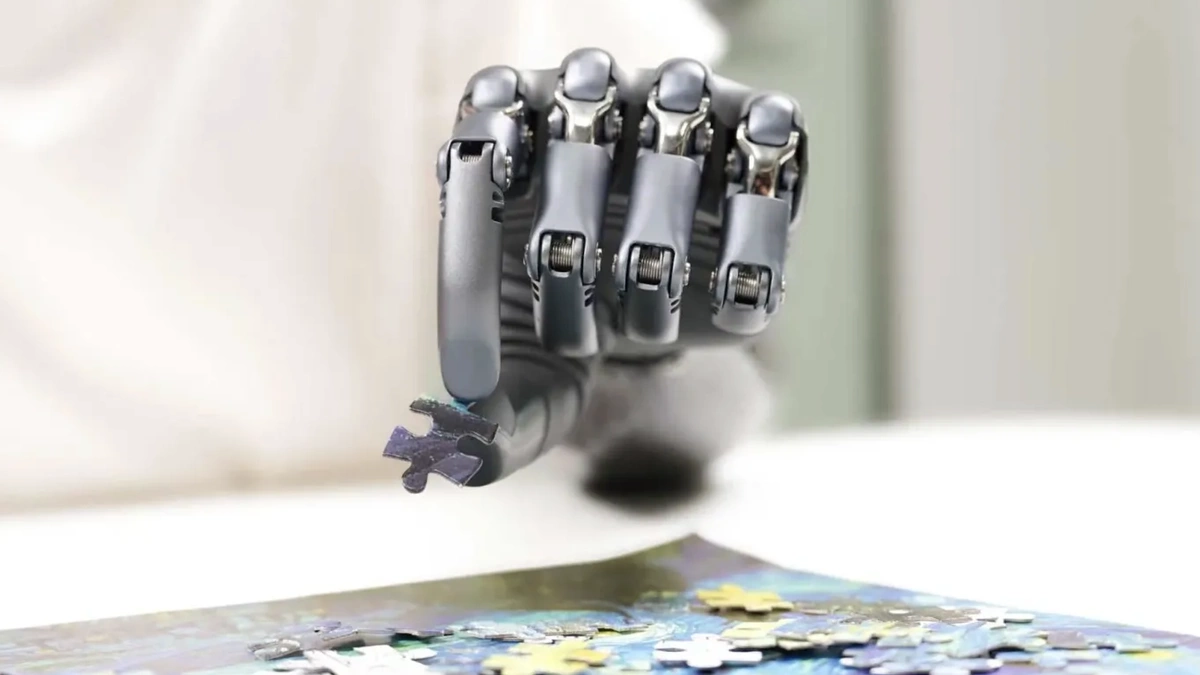
At the Brain-Computer Science Innovation and Demonstration Center (BCI Science Innovation & Demo Center) in Yuhang District, Hangzhou City, Zhejiang Province in late May, a BrainCo employee, who lost both hands, was able to continue his passion for calligraphy by using a smart robot hand to hold a pen and ink.
Behind it is BrainCo’s non-invasive BCI technology. At one-fifth to one-seventh the price of comparable foreign products, these bionic hands reflect how private Chinese companies are converting cutting-edge technology into practical applications aimed at a large and potential market.
A robotic arm from BrainCo. Image: BrainCo
BCI is a combination of the human brain and computer, translating brain activity into messages or commands for interactive applications. Not only supporting sick people, technology is expected to enhance the abilities of healthy people, helping them complete tasks that were previously impossible.
In January, at an event in Beijing, BrainCo introduced the FocusXin medical device to help improve attention deficit hyperactivity disorder (ADHD) for children. The product includes rehabilitation training software and a single-channel frontal lobe electroencephalogram (EEG) receiver, both of which have been granted a medical device registration certificate, working in combination to train attention span for children with ADHD. The device was assessed by Mr. Zhang Guojun, former party secretary of Beijing Children’s Hospital, as having the potential to become a specialized medical device, providing new intervention methods for problems that are difficult to solve with medication.
“BrainCo’s dexterous hands are applied by several companies that produce humanoid robots, which are the core components of physical artificial intelligence, which can be applied to both medical rehabilitation and industrial deployment,” Han Bicheng, founder and CEO of BrainCo, told Xinhua News Agencyadding that the company’s products are on the market in more than 35 countries and regions.
“Little Dragon” was founded in America
Dubbed one of the “six little dragons of Hangzhou”, BrainCo – known in China as Zhejiang Qiangnao Technology Company (Zhejiang Qiangnao Technology) – was founded by engineer Han Bicheng in the US in 2015, while still studying for a doctorate at the Brain Science Center of Harvard University.
Incubated at Harvard Innovation Labs, a year later, BrainCo received $5.5 million in investment capital to develop its first product Focus 1. The following year, the company received $15 million from Chinese investors. By 2018, BrainCo moved its headquarters to Hangzhou, China but still had an office in Somerville, Massachusetts.
Earlier this year, BrainCo successfully raised two billion yuan ($280 million) in a funding round co-led by IDG Capital and Walden International, the venture capital firm founded by Intel CEO Lip-Bu Tan.
Theo BigGo FinanceBrainCo’s 2025 revenue is estimated to exceed 800 million yuan (115 million USD), an increase of more than 100% over the previous year. Net profit is estimated at nearly 120 million yuan (17.7 million USD), showing that the business is starting to make a profit because it only focuses on expanding its scale. Earlier this year, the company filed for an IPO on the Hong Kong Stock Exchange and is waiting for approval.
“Non-invasive” direction
Unlike Elon Musk’s Neuralink solution or China’s StairMed and NeuroXess, which require brain surgery and implantation, BrainCo aims for a non-invasive product. According to Nyx He, Vice President of BrainCo, implantable and non-invasive methods are two different paths, “solving different problems”.
“Some diseases can only be treated through intervention in the brain, but BrainCo believes that many other diseases, especially those where drugs are ineffective, can be treated non-invasively, easily accepted and accessible, with lower risks and costs,” she told CNBC.
According to her, the core challenge for a non-invasive solution is capturing and decoding brain signals, which are “delicate” and prone to noise when read from outside the skull. The company has developed a dry electrode sensor to receive signals, with an AI algorithm to decode.
BrainCo also outlined a development roadmap in stages: starting with those who need technology the most, such as people with limbs covered by insurance; expanding to conditions such as ADHD and depression; integration into consumer electronics; and eventually licensing to businesses developing brain technology products.
Experts currently have mixed opinions about BrainCo’s path. “Non-invasive methods are like trying to capture light in distant galaxies,” commented Alex Zhavoronkov, CEO of biotechnology company Insilico Medicine.
Thomas Tsao, co-founder of venture capital firm Gobi Partners, assessed that BrainCo’s method provides a more comprehensive view of the brain without the risk of surgery. However, the market and public acceptance of this type of device is “hard to imagine at present”.
In a report dated July 8, investment bank Jefferies in New York identified the invasive implant solution as the “most promising” direction, as conventional non-invasive systems are limited by their ability to accurately receive and interpret brain signals. However, they still consider BrainCo to have a competitive advantage thanks to its ownership of many proprietary sensors, AI decoding algorithms and proven commercialization achievements.
According to industry experts, no matter the solution, the best method depends on the actual use. Dependent factors include recording or stimulating brain activity, patient or consumer orientation, short-term or continuous use, targeting superficial or deep brain areas, and user tolerance.
Controversial
BrainCo develops its product portfolio around three main areas, including rehabilitation, brain activity monitoring wearables and AI platforms. The most prominent is the BrainRobotics line with smart prosthetic hands and legs controlled by nerve and muscle signals, which has been Time honored in the top 100 inventions of 2019. Other devices with EEG such as FocusCalm, FocusClam, OxyZen and Eassleep serve to monitor concentration levels, sleep and brain health.
The photo of a student wearing a Focus 1 bracelet once caused controversy. Image: BrainCo
Besides hardware, the company provides an AI platform that analyzes EEG signals in real time, forming a combined ecosystem of devices, software and services. However, throughout the journey, many products received mixed reactions.
In 2016, BrainCo introduced Focus 1 – a headband that detects and reports brain activity through EEG. The device quickly appeared in some schools under the name Focus EDU, where teachers could see whether students were paying attention based on EEG scores.
Despite winning a number of awards for educational and medical equipment, Focus 1 still failed in its introduction at the 2016 CES Consumer Electronics Show in the US, being Daily Dot called it “the most embarrassing performance at the event”. But a year later, the device was improved by BrainCo and worked well during a live demo at CES 2017.
In 2019, images of students at an elementary school in Zhejiang province wearing EEG Focus 1 during class spread on social network Weibo and caused concerns about data collection. Information from SCMP that year said the bracelet had been tested on 10,000 students aged 10 to 17, leading many to say it “could lead to the formation of a surveillance society”.
On its website at the time, BrainCo said the information collected could be used to design concentration training games, helping students prepare their brains for optimal performance before starting class. According to MIT Technology Reviewdespite the controversy, the company still won a number of large contracts, aiming to ship 600,000 units. By 2021, the product changed its name to FocusClam, used to help users relax.
Some students in the US use Focus 1. Photo: BrainCo
In 2025, BrainCo was caught up in controversy again after a report by Hunterbrook Mediawhich questions the collection of EEG data from foreign users and privacy risks. Some US lawmakers sent a letter to the Department of Commerce arguing that the neural data that Chinese companies collect from US users poses potential risks to privacy and national security. BrainCo denied, saying the company complies with data protection regulations in the markets it operates. To date, no official conclusions have been announced.
China’s strategy
Theo CNBCthe rise of BCI businesses like BrainCo increases tensions in the competition between the US and China. Beijing recently included this technology in the “future industry” category in its latest Five-Year Plan, while promoting the development of brain implants.
In August 2025, seven Chinese ministries jointly issued a plan to promote the BCI industry, aiming to achieve an important breakthrough in 2027. In June, the Anhui provincial government announced an action plan to accelerate BCI development in the fields of research, production and industrialization.
Hospitals and schools are also not left out of the wave. Shanghai has connected BCI startups with Huashan hospital, expanding access for patients and neurosurgeons. Some Chinese health authorities also created separate insurance categories for BCI last year, which experts say could help scale the technology.
“China is now integrating BCI into its policy apparatus on an industrial scale,” said Paul Triolo of consulting firm DGA-Albright Stonebridge Group. “Beijing isn’t just thinking about a single disruptive technology, but the entire supply chain.”
According to the Grand View Research report in early 2026, the total global BCI market reached 168.27 billion USD in 2025, expected to grow at an annual rate (CAGR) of 1.52% in the period 2026-2033. As for non-invasive BCI, the market will reach 397.59 million USD in 2025, expected to grow at a CAGR of 8.73% in the same period thanks to the demand for rehabilitation, health care and consumer applications.
Alison15
unknown
Willis Fleming
Perez Waylen on We Don’t Have Time
Rogerseliana | POTOFU | POTOFU
@Danielgriden
Edwardsgreta39
Tag – close | Academy
Roberts Miguel | POTOFU | POTOFU
notepad.pw / ul3uw0jy
unknown
The role of reviews in choosing modern online services
Wilson Phillip
How reviews help you navigate online platforms
Anderson Isabelle | MyOwnMusic
Lianas Hent
1404
unknown
Danas internet nudi širok raspon uzbudljivih igara i zanimljivih recenzija kasina
Yulianna | MyOwnMusic
Williaminajohnson254
notepad.pw / dsu2kplj
Adams Mia | POTOFU | POTOFU
1405
M44732822