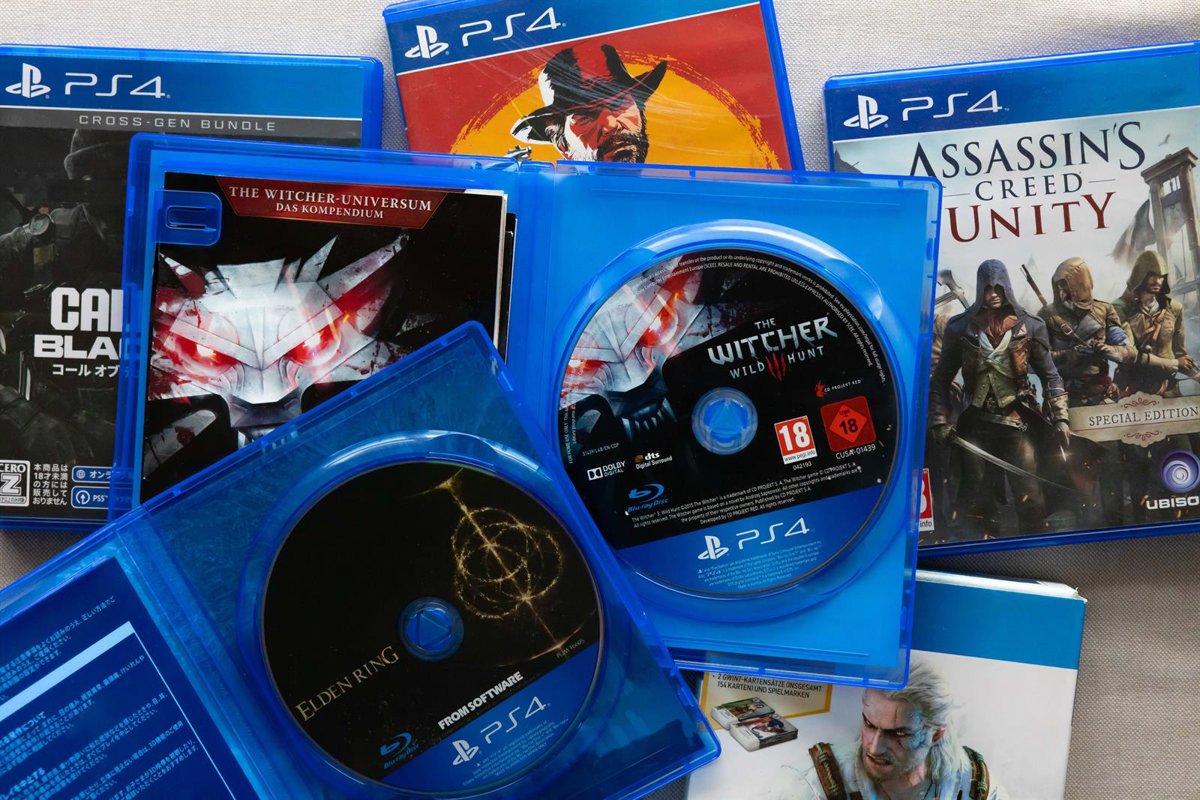
The European Union has assured that cannot intervene in Sony’s decision to stop producing physical video games starting in 2028, claiming that companies “are free to offer games and services in any way they see fit,” as long as consumer rights are protected.
The video game company announced in early July that will stop producing physical discs for all new games that will be released on PlayStation consoles starting in January year 2028thus marking the end of a stage for video games on CD that will become exclusively digital.
This decision has led to criticism from the gaming community, who have pointed out that it is a delay in terms of what it implies for the property, the price and the conservation of video games.
Now, the European Union has spoken out on the matter and has assured that cannot intervene in the decision of the video game companyas clarified by the European Commissioner for Justice, Michael McGrath.
According to statements to the press reported by the Irish Mirror, McGrath explained that these types of strategies are protected by “commercial and contractual freedoms”, so companies “are free to offer games and services in any way they see fit.
Of course, he has stressed that these decisions are valid “as long as consumer rights are fully protected in accordance with national and EU law”.
One of the main drawbacks that the exclusivity of digital games entails is related to the ownership of the title, and is that, unlike when buy a recordwhich can be keep and use for the desired timehe digital format only sells user licenseswith which users are left at the expense of the distribution platforms not close the servers or establish new requirements to access the titles already acquired.
In response to these types of actions, the Stop Killing Games initiative emerged in 2024, a campaign that seeks to resolve the “planned obsolescence” of video games. legally demanding that video game companies leave the titles purchased in a functional state when their official support ends.
Specifically, McGrath has also made reference to this project in his statements, claiming that they had to examine “a European citizens’ initiative on the question of whether games should still be available after a new edition has been released of the same game.”
However, the European Commission already issued its decision last June, when it determined that They do not find a basis to propose legislative changes that force video game studios to offer ways to preserve their titles after servers close.
Despite this decision, Brussels emphasized promote dialogue with the industry to design “a code of conduct” volunteer that addresses “how to manage the endgame.”
Taking all this into account, for the moment, the European Union will not be able to influence Sony’s position, that will continue with the end of video games in physical format by 2028.
It should be noted that, within this framework, the video game community has organized itself into a new global initiative call ‘Don’t Kill the Disc’created on Chnge.org, where they are collecting signatures to ask PlayStation to maintain the production of physical discs as an alternative to the exclusively digital version. Currently, this initiative has 309,736 signatures collected.
Kazino online
Kazino
PaperCall.io
Online casino juegos – BillionAnswers
Recensione su Casino Giuseppe a Matera (MT): l'opinione di Gastino Gangster
Online casino games | Talkfever – Growing worldwide
PaperCall.io
¿Qué casino me recomiendas? – BillionAnswers
Juego En Internet
PaperCall.io
Casino – BillionAnswers
56749 Juegos Online Casino.Html
Casea Casino España – Mejores Juegas de Azar y Apuestas
Online casino
CasinoLab Casino – Bono de Bienvenida hasta 500€
PaperCall.io
¿Dónde puedo encontrar un buen casino? – BillionAnswers
56750 Juegos.Html
Juego realmente satisfactoria
56751 Online Casino Juegos.Html
Casino juegos
El Entretenimiento Online Y La Importancia De Una Experiencia Equilibrada
billymolle Publisher Publications – Issuu
warren lotus
Tom Lowes,