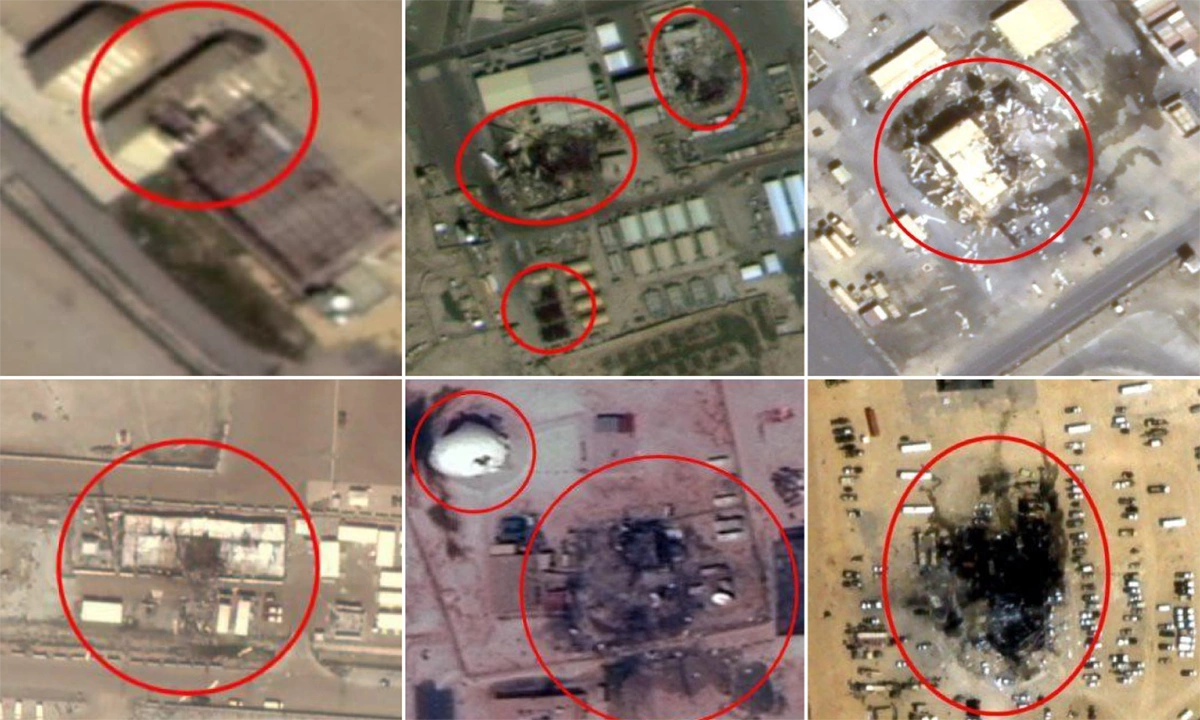
Damage at a series of Middle East bases shows that the US has underestimated Iran’s offensive capabilities and is not fully prepared for conflict.
Washington Post On May 6, it announced the results of analysis of 109 high-resolution satellite images published by Iranian state media, taken from late February to April 14, which showed damage at a series of US garrison bases in the Middle East.
The photos were authenticated by comparison with low-resolution images taken by the European Union’s (EU) Copernicus satellite system, as well as high-resolution satellite images from US-based Planet Labs. 19 photos released by Iran were eliminated because clear conclusions could not be drawn after comparison.
“None of the photos show signs of being edited,” the Washington Post said.
Damage at US garrison bases in the Middle East in satellite images released by Iran. Image: Washington Post
When studying Planet Labs’ own photos, the US newspaper identified 10 more destroyed or damaged structures that did not appear in the photos released by Iran. The Washington Post recorded a total of 217 structures and 11 pieces of military equipment that were destroyed or damaged at 15 bases where US forces were stationed during the 6-week Middle East conflict.
The targets hit included hangars, barracks, fuel depots, aircraft, key surveillance radars, Patriot air defense complexes and communications. More than half of the damage occurred at the US Navy’s 5th Fleet headquarters in Bahrain and three bases in Kuwait including Ali al-Salem, Arifjan and Buehring.
A US official said bases in Bahrain and Kuwait were among the targets that suffered the heaviest damage, likely because the two countries allowed the US to use their territory to attack Iran. Some Gulf countries have refused to allow the US military to carry out attack missions from bases on their territory.
“The level of destruction is much greater than what the US government publicly admits or previously published information,” the Washington Post said.
In the early weeks of the conflict, a number of media outlets published damage assessment results for US forces, including New York Times discovered 14 US military facilities and air defense sites that were attacked.
NBC News Late last month, an Iranian F-5 fighter broke through the US multi-layered air defense network and bombed the Buehring base in Kuwait, adding that 100 targets at 11 military bases were hit. CNN Last week, it was reported that 16 US military facilities were damaged.
However, satellite images analyzed by the Washington Post show that the number of targets hit is even higher than the above level. According to experts, this shows that the US has “underestimated Iran’s targeting capabilities”, has not adapted to modern forms of unmanned aerial vehicle (UAV) warfare, and has not applied adequate defense measures.
“Iran’s attacks were very accurate. There were no craters due to misses,” said Mark Cancian, senior advisor at the US-based Center for Strategic and International Studies (CSIS).
Location of US military facilities hit (yellow). Graphics: Washington Post
However, some damage may occur after US forces have withdrawn from the base, so the task of protecting structures there is no longer so important. Cancian and other officials believe the attacks from Iran have not significantly limited America’s strike capabilities.
CSIS experts added that some of the damage appeared to stem from deliberate decisions or diversionary measures.
“To preserve expensive interception weapons, US forces may have proactively let enemy missiles pass through after determining that the targeted target is not important. It is also not excluded that US commanders deliberately deceive Iran by making evacuated bases look like they still have full force,” he said.
Efforts to determine the damage caused by Iran have been difficult because Vantor and Planet Labs, two of the largest commercial satellite image providers in the US, have complied with Washington’s request to limit, delay or stop indefinitely the publication of satellite images of the Middle East region. These restrictions were imposed less than two weeks after the conflict broke out.
Meanwhile, Iranian state media has regularly published high-resolution satellite images since the beginning of the conflict.
The Patriot system let Iranian missiles target a base in Jordan in a video posted on April 2. Video: X/Clash Report
Central Command (CENTCOM), the agency in charge of US military operations in the Middle East, refused to comment on the information.
A Pentagon spokesman denied that the damage at the above bases was serious and reflected the failure of US forces. This person said assessing the level of destruction is “a complicated process and can be misleading in some cases”, but declined to provide details.
According to US military data, a total of 13 soldiers were killed in the Middle East conflict, of which 7 died due to Iranian raids on US bases. The fighting also injured more than 400 American soldiers. Most returned to duty after a few days, but there were at least 12 serious injuries, the Washington Post quoted unnamed US officials as saying.