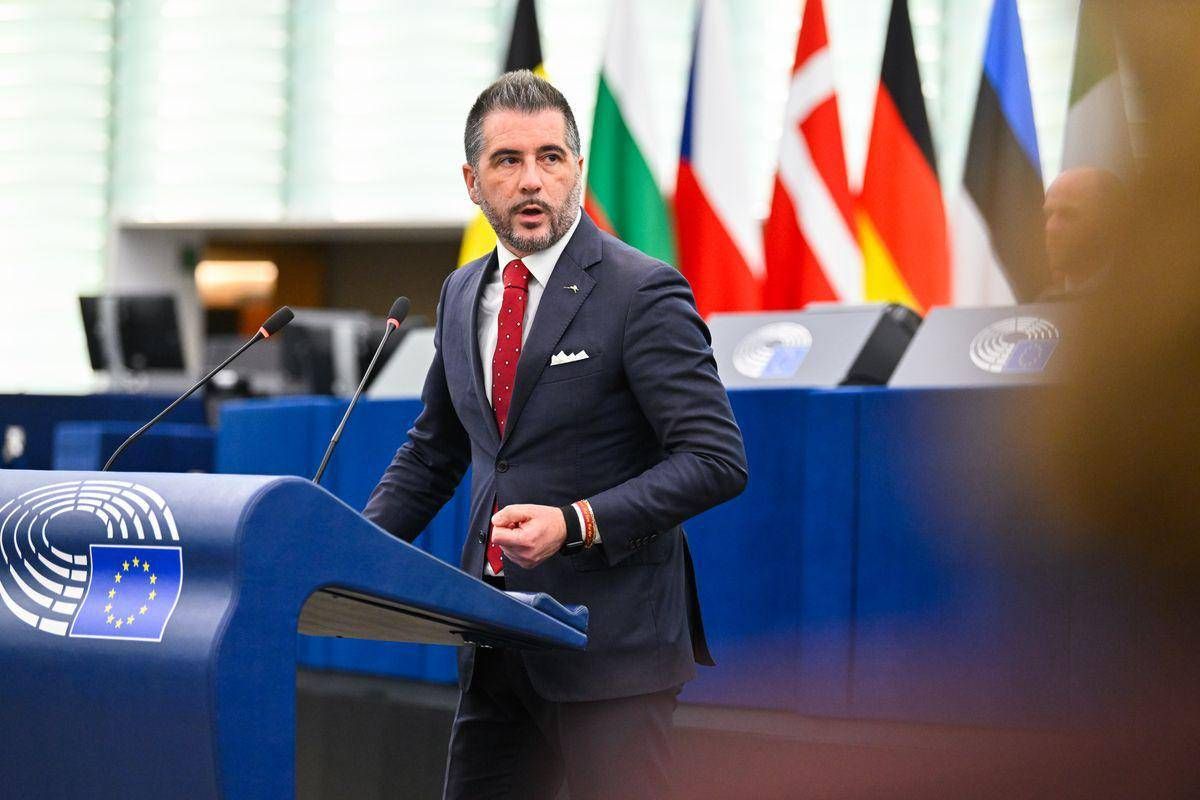
The ambitions of building a trade policy that leads to the EU’s objectives, including strategic autonomy, clash with the profound differences in interests and production systems of its countries. This is the line of reasoning of Paolo Borchia, head of delegation of the League (PfE) and member of the Industry, Research and Energy Commission at the Eurochamber, expressed during the Adnkronos live broadcast “Lavori in Corso”. This, he adds, is the basis of the “many difficulties we encounter on a daily basis”, including that in competing and responding to the challenge represented by China.
“We can only hide at the level of strategic autonomy we have big problems“, notes Borchia, giving as an example the abandonment of lithium refining processes, a key element for the transition, “because they were considered too polluting: China made different choices because it could make them”. Likewise, 95% of polysilicon, fundamental for the production of solar panels, is produced in the Xinjiang region, where there are “forms of production linked even to the slavery” of the Uyghur population. “Starting from this basis we must realize that we are operating in a profoundly asymmetric context” and that, numbers in hand, Beijing should be seen as “an interlocutor with which not to be closed, but at the same time to be firm”.
The MEP opposes the Chinese authoritarian system with the EU, “an institution made up of different states that have different interests in foreign policy, different production systems”, within which “producing countries, countries that have manufacturing, countries that have agri-food production and countries that instead limit themselves only to imports coexist with difficulty. Therefore, when we talk about commercial policy and free trade agreements, we must recognize that too often the drop point may not suit everyone“, since the differences between states cannot be easily overcome. “We are reasoning with two actors who have profoundly different characteristics, and I think that these are also at the basis of many difficulties that we encounter on a daily basis”, he concludes.
Steel, extend limits to protect EU producers
The need to defend the internal market fits into this framework. The League delegation welcomes “with confidence” the vote with which the European Parliament has cut steel import quotas into the EU by 47% and raised the duty for non-quota imports to 50%. It’s one started with 300,000 jobsunderlines the Northern League member, whose opposition group supported these measures.
European producers “have worked and invested in research and innovation to be competitive and sustainable”, but the consequences of “differential in cost structure with Chinese manufacturers” compared to the European steel sector, which is in difficulty like the Italian one, explains the MEP. Added to this are the high energy costs in the EU, which have a profound impact on such an energy-intensive sector, as well as the weight of more demanding regulations. “So we hope that this very large majority vote, also because there are not many measures that pass with 606 votes in favor in the chamber, can actually be useful towards producers”.
Borchia underlines that the problem of Chinese overcapacity is not limited to the steel industry alone: there are various sectors in which Chinese producers “on the one hand enjoy a much lower cost structure compared to ours”, on the other hand they benefit from public subsidies which makes them “extremely competitive globally”. And at a time when the United States has chosen to protect its producers by raising tariffs, Europe “has become an ideal outlet market to vent this overcapacity”. The MEP believes that in the future it is necessary to evaluate whether extend these defensive measures to other sectors to “defend our producers”.
Energy, we need the broadest possible mix with gas and nuclear
Also weighing on the competitiveness of the industry, as mentioned for the steel industry, is the cost of supplies. The recipe for the future “is to have gods the widest possible energy mixesbecause now objectively the blanket is short, the choices we can make are few”. We need the ability to “think about a mix in a non-prejudicial, non-ideological way, but in a very realistic and functional way according to the needs of the country and its economy”.
As the MEP points out, photovoltaic panels are an element that can contribute to the mix, “but we must not hide the fact that they are sources of intermittent energy and not programmable”. On the hydroelectric side, Italy comes “from an important tradition” of development, but in 2022 generation collapsed by 45% “due to drought”.
There is therefore no plan B, “which from my point of view would include a balanced mix where gas is used when neededalso because we have a very modest domestic production compared to our needs”. And on the other side “there is the great issue of nuclear powerwhich we cannot ignore due to a number of factors, from the security of supplies to the stabilization of prices”. (by Otto Lanzavecchia)
https://www.scenario.press/blogs/382169/How-Businesses-Evaluate-Zoho-Against-Other-CRM-Platforms
https://www.glbrain.com/index.php?r=content/view&id=50156
https://webhitlist.com/profiles/blogs/choosing-between-zoho-and-other-crm-platforms-in-a-changing
https://jogajog.com.bd/blogs/115059/AI-for-Small-Business-How-Zoho-and-Modern-Tools-Are
https://mushlovesocial.com/blogs/217959/AI-for-Small-Business-Practical-Automation-Smarter-Decisions-and-the
https://tannda.net/read-blog/343623
https://krypto.fria.ifokus.se/discussion/1642976/zoho-crm-vs-pipedrive-a-practical-comparison-for-sales-driven-businesses
https://ivebo.co.uk/read-blog/321385
https://daddycow.com/blogs/view/108092
https://redesocial3.ainfinity.com.br/read-blog/2062
https://magic.ly/nikol123/Building-Business-Efficiency-Through-Zoho-Solutions
https://globbook.com/blogs/74849/How-Zoho-Solutions-Help-Businesses-Streamline-Operations
https://blogs.bangboxonline.com/posts/the-role-of-zoho-partners-in-modern-business-management
https://raovat49.com/s/why-businesses-turn-to-zoho-consultants-for-operational-growth-6480642
http://prsync.com/how-zoho-consulting-supports-business-process-opti/
https://social.japrime.id/read-blog/442599
https://payrchat.com/blogs/67555/improving-business-performance-with-zoho-consulting-services
https://differ.blog/p/why-businesses-choose-zoho-partners-for-digital-transformation-8b0fc4
https://bots.ondiscord.xyz/lists/SKdZf786w
https://wemixplay.com/community/YMIR/12/617
https://top.jbnu.ac.kr/bbs/MCDL/4234/391746/artclView.do
https://www.cqcinvestigations.co.uk/how-a-zoho-consultant-helps-businesses-transform-operations/
https://www.jointcorners.com/read-blog/189615
https://beterhbo.ning.com/profiles/blogs/how-zoho-consultants-help-companies-improve-structure-efficiency
https://www.wikiful.com/@Leila123/revolut-online-casino-digitale-betalingen-in-een-snel-evoluerende-gokindustrie/how-zoho-consulting-helps-businesses-build-efficient-digital-operations