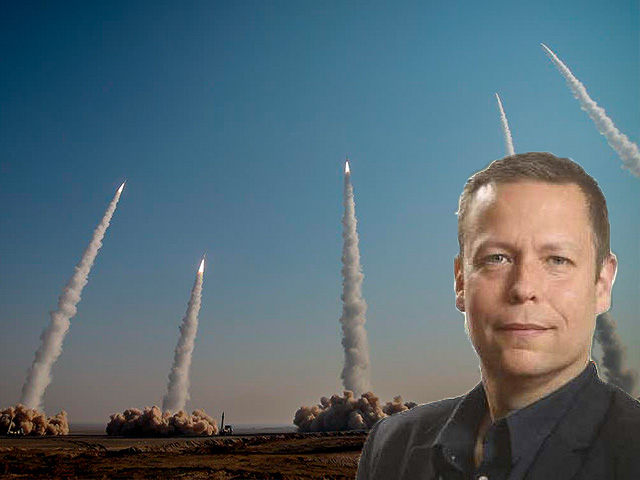
Dr. Raz Zimt, an Iran expert at the Alliance Center for Iran Studies at Tel Aviv University and the Institute for National Security Studies, commented on the escalating tensions between Iran and Israel.
Interviewed by Michael Borodkin, Oriental Express. The interview was organized with the help of Gurevich Tikshoret.
Let’s start with one news report. Russian resources reported that about a year ago, Sharofiddin Gadoev, one of the leaders of the Tajik opposition in exile, wrote a letter proposing cooperation between the pro-democracy forces of Tajikistan, Afghanistan and Iran against the Islamic Republic, in alliance with Israel. You have been listed as one of the recipients of the letter. How do you like it?
I can’t say anything about the content of this appeal. I don’t remember seeing this letter, but perhaps I saw it, didn’t read it, and simply forgot about it, or it was blocked by our mail system. There have been many hacking attempts, so increased precautions are being taken.
Okay, then let’s move on to the question of the opposition. Is there any real opposition in Iran today?
No, there is still no real opposition in Iran. The regime carefully monitored and is ensuring that no one ever speaks out against the Islamic Republic. It is possible to criticize certain aspects of government policy, but challenging the foundations is strictly prohibited. So there is no organized opposition force within the country.
There is opposition abroad. However, these oppositionists have two main problems. Firstly, they are very fragmented and cannot unite in any way. Secondly, they do not have a serious network inside Iran to guide the actions of those dissatisfied with the government. This is not to say that the opposition in exile has no support. The riots of December 2025 – January 2026 showed that many people took to the streets with the name of Prince Reza Pahlavi and under monarchist slogans. But the prince was never able to create a large opposition structure within Iran that could challenge the regime.
Is it possible to define the events that took place in Iran after the death of Ali Khamenei as a military coup?
No, I don’t think so. I believe that it is Mojtaba Khamenei who has the final say in the decision-making process. It is, to put it mildly, not easy to control remotely, be it for health or safety reasons. However, the country’s collective leadership, which today includes IRGC commanders, the president, the head of the security council and several other figures, usually does not act without the approval of the supreme leader. Yes, the influence of the IRGC, already significant, has sharply increased. But Mojtaba Khamenei is not their puppet. They truly consider him their leader.
Although no one has seen or heard of him yet, and his qualities do not suit him for the post of supreme leader – he is a minor theologian.
His figure as a successor, of course, caused a lot of controversy when they first started talking about it. And the main criticism at that time was not that he was not suitable for the position of rakhbar due to a weak understanding of theology, but the fact that in such a scenario, supreme power is inherited. If Ali Khamenei had passed away naturally, then perhaps there would have been a different rahbar in Iran. But because of the war, Mojtaba Khamenei’s supporters managed to get his candidacy approved, not without some pressure on everyone else, of course. There are dissatisfied people, but they are still silent. When the war is over, the situation will become clearer, and we will have a better understanding of what the internal situation is there and what the state of the new supreme leader is. We really haven’t seen or heard from him, but among the Iranian leadership there are those who communicated with him, although access to him, of course, is very limited.
I note that despite reports that many Shia cleric leaders are unhappy with the situation, I doubt that after the war they will openly challenge Mojtaba Khamenei. If the IRGC is completely behind it, then it will be too difficult to oppose it.
How do you comment on the plan to use Iranian Kurds to overthrow the regime? This seemed strange to me, because most Iranians would perceive the Kurdish uprising as separatism, and Iranian public opinion is extremely sensitive to such things.
Yes, you’re right. The plan to use the Kurds is problematic for two reasons. The first one you mentioned is suspicions about the separatism of Kurdish organizations. The second reason is that any revival of Kurdish national movements causes a violent reaction from various forces in the region, primarily Turkey. And so it happened, Erdogan intervened in the events to prevent a Kurdish uprising in Iran.
The plan itself looked strange. It is one thing to provoke tension in a particular Kurdish region of Iran. This could well be expected. It is quite another thing to hope that the Kurdish uprising will cause similar protests in all other regions of Iran. This is at least a strange hope. However, if we take into account that it seems that there was an even stranger plan, with Mahmoud Ahmadinejad brought to power, then perhaps there was indeed an expectation of a full-fledged uprising.
Ahmadinejad’s plan was reported by a rather unreliable source…
It’s not that simple. I have reason to believe that not all information about the bet on Ahmadinejad was false.
How do you explain yesterday’s and today’s shelling?
The Iranian regime under the new leadership has become more radical and more decisive, more ready to act. They pursued several goals. First, to show that obligations to Hezbollah are being fulfilled. The regime attaches great importance to its Lebanese allies, which it demonstrates in action. Secondly, Tehran is confident that US President Donald Trump is absolutely not interested in resuming full-scale hostilities. Therefore, it is possible to deliver such a blow. Their self-confidence grew as the war progressed, thanks in large part to the effective closure of the Strait of Hormuz and the problems Iran created for the Arab Gulf states. Today they are convinced that they will not only survive this war, but may even emerge from it as real winners.
The American blockade does not scare them.
No, it’s not scary. This regime is accustomed to operating in conditions of economic problems, and its pain threshold is very high. Yes, the economic situation in Iran is very difficult, there is nothing to argue about. But the regime is ready to tolerate this for some time, apparently even longer than the United States is ready to tolerate the blocked Strait of Hormuz. The American blockade sharply reduced Iranian oil exports, but it should be remembered that a huge amount of Iranian oil was already on tankers outside the blocked zone. Add to this the jumping prices, and it becomes clear that they will have enough resources for some time. Not for many years, of course, but for now they are coping. The Iranian leadership is confident that they will have the patience to impose favorable conditions for a permanent ceasefire on the United States.
https://bk33casino.cc/slots
https://bk33casino.cc/app
https://bk33casino.cc/about-us
https://ek333-play.com
https://ek333-play.com/login
https://ek333-play.com/bonuses
https://ek333-play.com/slots
https://ek333-play.com/app
https://ek333-play.com/about-us
https://ek333bd.cc
https://ek333bd.cc/login
https://ek333bd.cc/bonuses
https://ek333bd.cc/slots
https://ek333bd.cc/app
https://ek333bd.cc/about-us
https://ek33.top
https://ek33.top/login
https://ek33.top/bonuses
https://ek33.top/slots
https://ek33.top/app
https://ek33.top/about-us
https://ek33.top/terms-and-conditions
https://ek333bd.top
https://ek333bd.top/login
https://ek333bd.top/bonuses