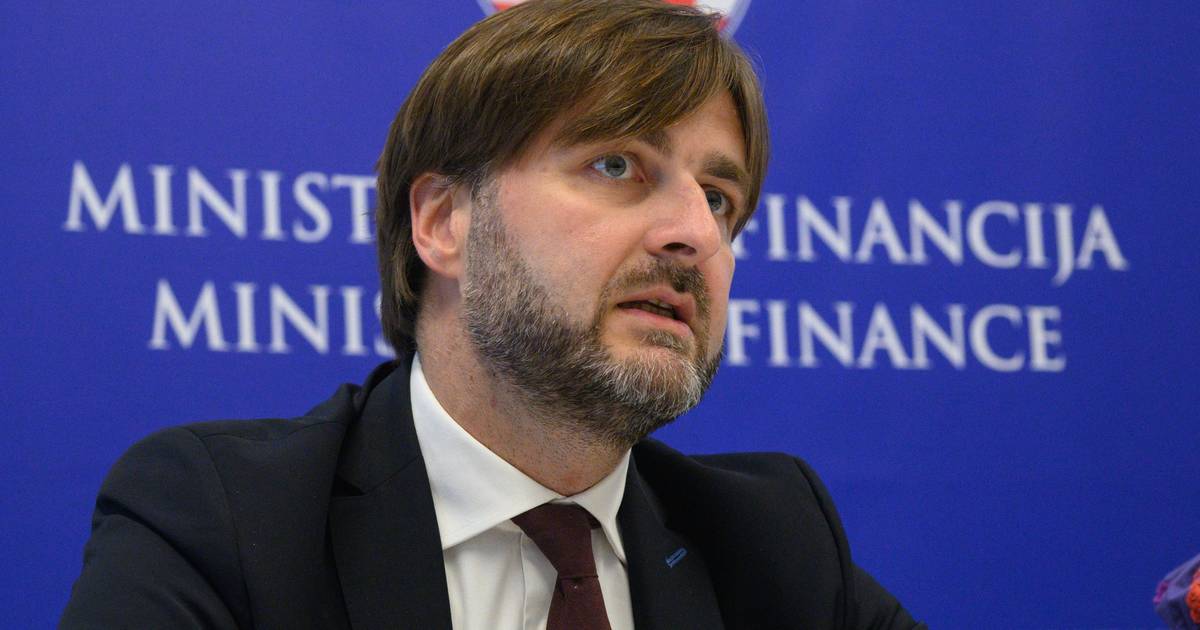
Minister of Finance Tomislav Ćorić on Wednesday, before the meeting of the parliamentary majority, he expressed the expectation that the inflation rate in Croatia in the first quarter of next year will drop to the level of the eurozone average, stating that he will be satisfied when it drops to around two percent per year.
“The trend is clear, in April it was 5.8 percent, in May 5.2 percent, now we are at 4.5 percent. What we expect is the continuation of the fall in inflation rates in the coming months and we believe that in the first quarter of 2027 we will record inflation rates at the level of the Eurozone average,” said Ćorić.
Answering a journalist’s question about what level of inflation he would be satisfied with, he said, “I will be satisfied when the level of inflation in the Republic of Croatia is around two percent per year.”
Earlier on Wednesday, the State Bureau of Statistics reported that inflation is most affected by the energy component, followed by the services component.
The Minister was encouraged by the fact that the prices of food, beverages and tobacco rose only 1.8 percent on an annual basis, that is, significantly less than the prices of energy, which rose 13.2 percent, or services, which rose 8.1 percent.
PPVRH and Minister @mfin_RH Ćorić: The inflation rate in June 2026 in Croatia is 4.5% compared to the same period last year. @StatistikaHR The largest contribution to the structure of this inflation still comes from the energy sector (13.2%), as well as services (8.1%). The fact that in… pic.twitter.com/PsIH1Mzaj3
— Government of the Republic of Croatia (@VladaRH) July 1, 2026
He explained that he expects a reduction in inflation to the European average during the first quarter of next year due to current trends, but also due to the fact that all measures from the anti-inflation package will be fully operational by then.
The minister pointed out that the package of tax laws, which will introduce anti-inflationary measures, will be adopted by the end of the year, that is, they will enter into force by the beginning of 2027.
Speaking about the package of anti-inflationary measures, the finance minister recalled that interested groups reacted to that package after the government presented it. He did not reveal whether any of the proposals of trade unions, employers, entrepreneurs and craftsmen would be accepted.
“When the by-laws come up for public debate, everyone will have the opportunity to comment. We understood some of the things they told us, we gave counter-arguments, it is, after all, a normal democratic process in these kinds of situations,” said Ćorić.
He added that the reaction of interested groups was expected, given that changes to the tax system are being proposed, both for flat-rate craftsmen or short-term renters, and for larger companies that enter the criteria for taxation of excessive profit margins.
Commenting on the possible increase in prices in catering and tourism in the current tourist season, Ćorić repeated that the government cannot directly influence the price of these services.
Pointing out that the government established control over key segments of state expenditures by setting budget limits for next year, he added that it insisted on solidarity and responsibility with all stakeholders, including public companies.
Therefore, it is logical, concluded Minister Ćorić, to expect from public companies the same as is demanded from the unions of public and state employees, who demanded an increase in wages.