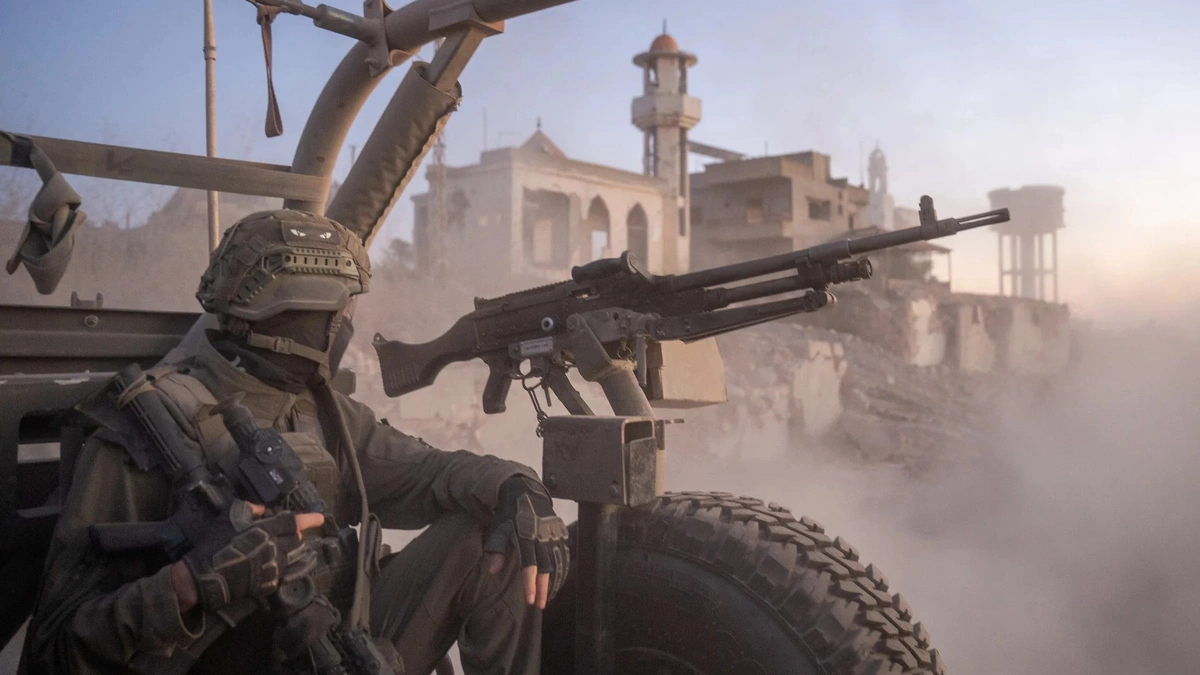
Israel is trying to find ways to deal with suicide drones, after more than 10 soldiers were killed and many pieces of equipment were destroyed because of this weapon.
First-person drones (FPV drones) move freely in the skies over southern Lebanon and northern Israel to hunt for enemies. After finding a suitable target, such as a state-of-the-art Merkava Mark 4 tank, an Iron Dome air defense complex or a group of Israeli soldiers, it will dive down to deliver a fatal blow.
FPV drones controlled by fiber optic cables have become Hezbollah’s main weapon in the conflict with Israel in recent months.
Hezbollah drones attacked the “gathering point” of Israeli soldiers and Merkava tanks in southern Lebanon in late May. Video: Hezbollah
At least 12 Israeli soldiers have died in Hezbollah’s FPV drone attacks since the war broke out again in March, equivalent to 1/3 of the country’s loss of life in Lebanon. A series of advanced Israeli weapons, including the Merkava Mark 4 main tank and the Iron Dome air defense complex, were also hit by drones.
Unlike the equipment Hezbollah has deployed to deal with Israel in the past, fiber optic FPV drones do not emit radio signals and are very difficult to detect. They can maintain a high-speed connection with the operator and cannot be jammed by electronic warfare measures.
FPV drones also have small size, low radar reflection area and high maneuverability, and can rush into targets from unexpected directions.
That is the reason why the Israel Defense Forces (IDF) are racing to find ways to deal with this dangerous weapon. “The threat from drones is a challenge, but we will overcome it. Technical and operational solutions are being developed,” Israeli army commander Eyal Zamir announced last month.
The race to find solutions to deal with Hezbollah drones
The IDF’s first step is to deploy hundreds of thousands of square meters of netting to protect soldiers in southern Lebanon, as well as bases in northern Israel. The protective net will cause the drone to get stuck before touching the target. In some cases, they caused the drone to explode at a distance far enough away that soldiers inside the vehicle were not killed.
The IDF is also equipped with hunting guns and fragmentation bullets to help soldiers shoot down drones at close range. However, for this measure to be effective, soldiers must know the drone is coming.
The IDF has not revealed how it will improve its ability to detect and track fiber-optic drones, or whether it has done so yet. However, this force has called on private technology and defense companies to develop and deploy measures to deal with suicide drones.
Operating principle of fiber optic drone. Graphics: BBC
Many Israeli businesses have met with IDF officials to resolve this issue. Some companies are developing non-radio sensors capable of detecting fiber-optic drones, while others are pursuing measures to intercept and neutralize drones before they reach their targets.
Tel Aviv-based company Airwayz said it has developed software capable of managing low-altitude airspace and identifying potential threats. Its technology has been deployed by the Miami Police Department in the US to help protect a stadium from drone threats during the 2026 World Cup.
Observers believe that it is necessary to simultaneously use many types of sensors, including optical, acoustic, radar and laser systems, to be able to identify approaching fiber-optic drones.
Airwayz said its system is capable of synthesizing data from many different sensors to quickly identify friendly or hostile drones.
“In most cases, soldiers can only hear the drone flying in and have about 3-4 seconds to react. If they had received a warning 20-30 seconds in advance, the result would have been completely different,” said Shai Kurianski, co-founder of Airwayz.
Kurianski admitted that Israeli soldiers are currently almost defenseless against Hezbollah’s fiber-optic drones, requiring the country’s high-tech industry to act urgently. “Soldiers participating in the war in Lebanon are being subjected to drones carrying explosives and we will not sit idly by in that situation,” he said.
The lack of preparedness of the Israeli army
Many Israelis feel frustrated that the IDF was not fully prepared for the serious threat that the force should have anticipated.
Fiber-optic drones appeared in the Ukraine conflict two years ago. Ukrainian officials also warned Israel about this weapon and offered to help Tel Aviv prepare measures to prevent it from being deployed in a conflict in the Middle East.
Israeli soldiers sit in a Humvee in southern Lebanon on June 18. Image: Times of Israel
“We don’t see much interest from the Israeli leadership on this issue. I don’t want to speculate about the reasons. I often see disappointment at Israel missing the opportunity to save the lives of more soldiers,” Ukrainian Ambassador to Israel Yevgen Korniychuk said in May.
Many current and former IDF officials admit that the country is not fully prepared to deal with drones.
Reserve General Yaron Rosen, former commander of the IDF’s cyber warfare department, pointed out that the Israeli army was “completely overloaded” when faced with too many threats on a series of fronts.
“Everyone was talking about it like ‘hey, that’s coming up’, but no one really knew. We were also thinking about other issues, especially Iran,” Rosen, now executive chairman of Airwayz, said when mentioning the threat from drones.
He emphasized that the IDF is “doing everything possible” to close the gap in defense capabilities, and also hoped that Hezbollah drones would have a sharp decline in operational effectiveness “in the next few months”.
Hastelloy Flanges Manufacturer, Supplier in Libya
Hastelloy Flanges Manufacturer, Supplier in Nepal
Hastelloy Flanges Manufacturer, Supplier in Philippines
Hastelloy Flanges Manufacturer, Supplier in Russia
Hastelloy Flanges Manufacturer, Supplier in South Korea
Hastelloy Flanges Manufacturer, Supplier in Sudan
Hastelloy Flanges Manufacturer, Supplier in Sweden
Hastelloy Flanges Manufacturer, Supplier in Taiwan
Hastelloy Flanges Manufacturer, Supplier in Tanzania
Hastelloy Flanges Manufacturer, Supplier in Thailand
Hastelloy Flanges Manufacturer, Supplier in USA
Hastelloy Flanges Manufacturer, Supplier in Vietnam
Hastelloy Forgings Manufacturer, Supplier in Austria
Hastelloy Forgings Manufacturer, Supplier in Belgium
Hastelloy Forgings Manufacturer, Supplier in Brazil
Hastelloy Forgings Manufacturer, Supplier in Egypt
Hastelloy Forgings Manufacturer, Supplier in Finland
Hastelloy Forgings Manufacturer, Supplier in India
Hastelloy Forgings Manufacturer, Supplier in Italy
Hastelloy Forgings Manufacturer, Supplier in Mexico
Hastelloy Forgings Manufacturer, Supplier in Nepal
Hastelloy Forgings Manufacturer, Supplier in Netherlands
Hastelloy Forgings Manufacturer, Supplier in Philippines
Hastelloy Forgings Manufacturer, Supplier in Singapore
Hastelloy Forgings Manufacturer, Supplier in Sudan