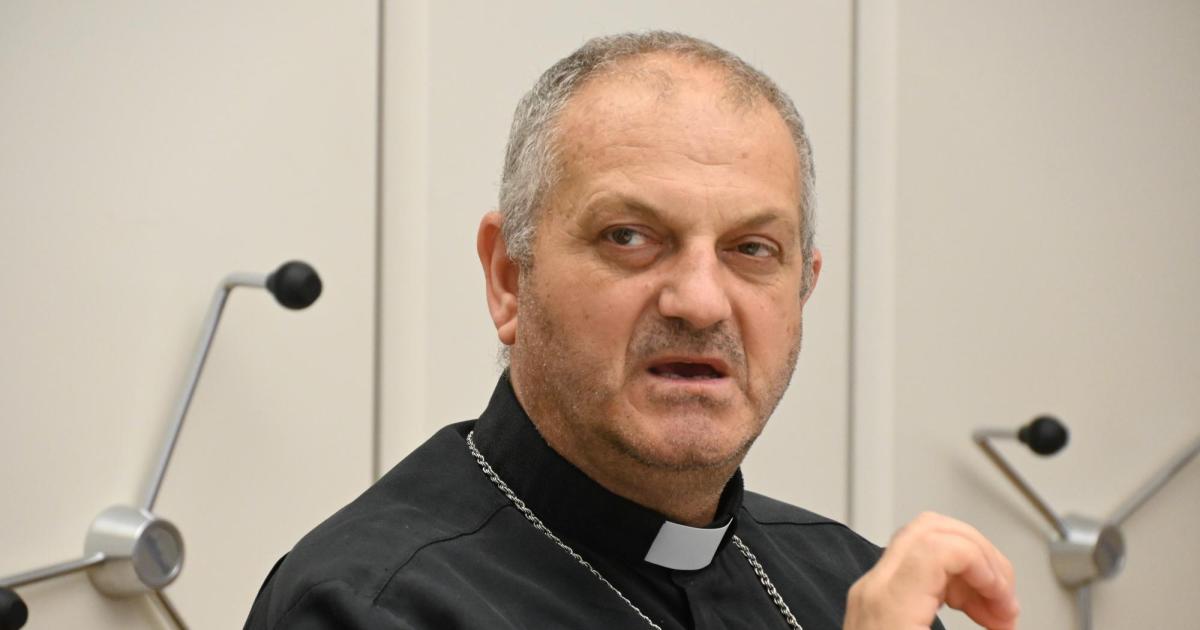
For three months the world was limited Jacques Mourad to a run-down bathroom. IS fighters had his monastery in the Syrian desert town in May 2015 Lying stormed after him together with a fellow priest Raqqa brought to the then capital of the self-proclaimed “Islamic State”. There the two Christians were locked in a bathroom because they were considered “unclean.”
The men repeatedly put the knife to their throats: “If you don’t convert to Islam, we will behead you.” But that didn’t happen. Instead, Mourad was allowed to return with hundreds of other Christian prisoners to Qaryatein – a city that was then bombed daily by the Syrian army.
It was only in October 2015 that he managed to escape with the help of Muslim civilians, all of whom were later murdered by IS. “For me it was a miracle,” says Mourad.
Even today, daily violence in Syria: “We are not free”
More than ten years later, Mourad sits as Syrian Catholic Archbishop of Homs in Vienna and tells journalists about another night that had the same impact on him. It was that one December 8, 2024the day on which Assad-Regime fell. “For me it was the first night without any negative feelings, I slept so peacefully,” remembers Mourad. And this despite the fact that people on the streets of Homs were shooting up for joy. For two weeks he and the whole city were “insanely happy”.
Then came December 25th, Christmas Day. In Homs, Alawites took to the streets to protest against violence by the new government led by the former Islamist rebel leader Ahmed al-Scharaa to protest. After five minutes the protest was over – the police had shot at the demonstrators and many had fled. “It was a sad moment when I realized: We are not free,” said Mourad.
The archbishop paints a gloomy picture of his homeland, where the security situation has only improved for the Sunni Muslim majority population since the change of power. In those regions where minorities live, however, everyday life remains life-threatening: “Someone is killed every week.”
Just last week in Homs, a young woman and her two children were shot and robbed on the street.
Christians are not even the focus of persecution
Numbers confirm the archbishop’s impression. In the aid organization’s 2026 World Persecution Index Open Doors Syria jumped from 18th to 6th place among the countries where Christians are most persecuted – the biggest jump since the list was first published.
In June 2025, a suicide bomber killed 22 people in the Greek Orthodox Mar Elias Church in Damascus, and in March 2026, armed fighters attacked Christians in the town of Suqaylabiyah near Hama. While there were around two million Christians living in Syria before the civil war, according to Mourad, there are still 300,000 to 350,000 today.
Christians are not even the focus of persecution by the new rulers. This is aimed primarily at the Alawites, who are assumed to be close to the old Assad regime – the dictator’s family also belonged to this minority – and the Druze in the south.
Both groups once split off from Shia Islam and would therefore be considered “misguided” by al-Sharaa and his followers. “This is not only politically motivated, but also deeply religious,” says Mourad. Christians would not be hated in the same way – but they are indirectly affected if the state loses control over armed groups in parts of the country.
The archbishop directs his criticism directly to Ahmed al-Sharaa: “I cannot accept this constant manipulation.” The interim president is selling himself abroad as a reformer, although there are just six Christians and five women in the new parliament, while around 70 percent of the MPs come from the Islamist stronghold of Idlib.
“Al-Sharaa doesn’t think about its people,” says Mourad. “The money for reconstruction goes almost exclusively into the pockets of Sunni Muslims.”
“I cannot advise anyone to return to Syria”
This assessment meets an uncomfortable present in Europe: Since the fall of Assad, the opinion has become widespread in countries like Austria that Syria is now safe enough for refugees to return. Mourad strongly disagrees. “I cannot advise anyone to return because the situation is unclear: we never know what will happen tomorrow.”
The country is still unstable and the poverty is enormous: “In this situation, no lifelong dream can be realized.” What the archbishop is calling for instead: infrastructure projects, schools, hospitals. “If a government in Europe seriously wants to rebuild Syria, then it must finally come and start! That is the only way to end the violence in the country.”