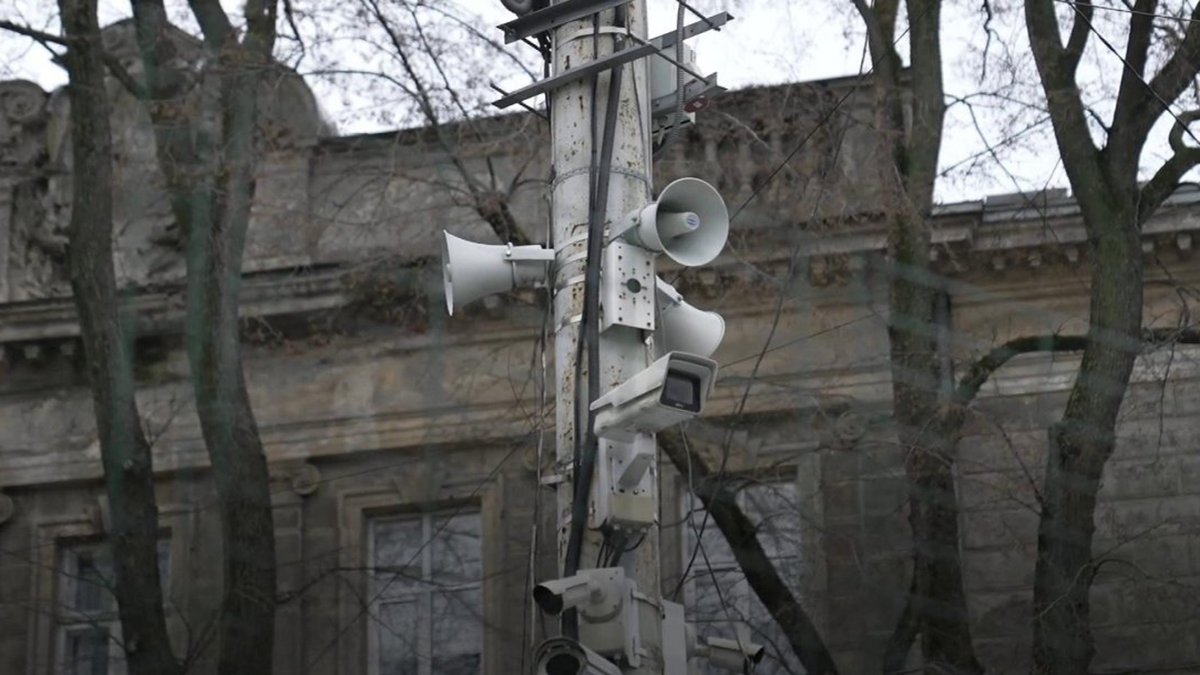
The siren did not sound during the drone exhibition near Kiev that was hit by an Iskander-M missile, possibly due to a delay in receiving the warning.
Yulia Gershun, who attended the exhibition of unmanned equipment (drone) on the outskirts of Kiev on July 24, said the siren was not activated before the Russian ballistic missile crashed into this location. “The first raid took place completely unexpectedly, not everyone understood what was happening,” she recalled.
Gershun said he heard the sound of a total of four ballistic missiles, with the second one landing about a few minutes after the first. She did not specify whether the sirens were activated after the first missile hit the exhibit.
Ukrainian officials did not mention the issue of sirens not sounding before the Russian missile descended. However, Serhii Beskrestnov, advisor to Ukrainian President Volodymyr Zelensky, mentioned this topic in an article posted on social networks in mid-month.
“Why do ballistic missile sirens sometimes sound only after the projectile has hit the target?” is the opening sentence of the article.
Exhibition scene on the outskirts of Kiev after Russia’s attack on July 24. Video: DSNS Ukraine
He said all information about Russia’s launches or launch preparations was provided to Ukraine by “partners”, seemingly referring to the US and its allies.
“We don’t know, and shouldn’t know, how they collect information. However, it doesn’t take a genius to realize that the main source of information is satellite monitoring of launch sites and missile data collection systems,” he said.
How the US detects ballistic missile launches
The US ballistic missile warning network has three layers, including satellites in orbit, ground radar and information receiving and processing stations. The satellite system acts as an “eye” in the sky, equipped with infrared sensors capable of detecting heat signals from the engine exhaust stream as soon as the rocket leaves the launch pad.
“The satellite not only sees the heat source, but also knows that heat source is moving. Experts will analyze the fast-moving heat source to determine whether it has characteristics consistent with a specific ballistic missile model, then provide data to interested parties,” US Space Force commander B. Chance Saltzman said in 2024.
After satellites detect the launch, US long-range radar stations will monitor the target in space, calculating the speed and flight path of the projectile.
US missile warning system. Graphics: Youtube/SamEckholm
One of them is the AN/FPS-132 active electronically scanned array (AESA) radar with two antenna faces, each managing its own airspace area with a 120-degree azimuth, providing a total viewing angle of 240 degrees and a maximum tracking range of 4,800 km. A cluster of 5 AN/FPS-132 stations is deployed by the US in the area to ensure 24/7 surveillance capabilities over North American airspace.
All information will be transferred to the command center, including the Buckley space base in Colorado. Satellite antennas placed in protective domes at the base will receive data and forward it to a team of experts to verify, analyze and send warnings in real time.
Procedure for activating air raid sirens in Ukraine
In Ukraine, the task of activating air raid sirens is assigned to emergency response centers located deep underground in each city. If Russia launches an attack, civilian experts will have to turn on sirens throughout the city to warn people, before the air defense network enters the fight.
On the radar map in the center there is a blue circle surrounding the city. Russian unmanned aerial vehicles (UAVs) can fly to the city within 7-8 minutes after appearing in the circle.
Most of their job is to wait patiently to see if any UAVs or hover bombs enter the warning area, because there is still a possibility that they will change direction or just fly over the city to attack another target. Experts usually do not activate sirens too early, to avoid making people uncomfortable and lose confidence in the warning system.
Speaker system in Ukraine in photo taken in 2022. Photo: BBC
With ballistic missiles, there is no waiting and the siren will immediately activate as soon as there is a launch. Iskander-M ballistic missiles can reach speeds of 7,400-8,600 km/h, so defense forces do not have much time to react.
“The rocket can fly to Kiev just a few minutes after leaving the launch pad,” Beskrestnov said.
In addition to detecting threats through the radar network, the centers also maintain direct contact with the Ukrainian military to receive warnings and receive information from foreign partners.
According to Mr. Beskrestnov, delays in information transfer can prevent the alarm system from being activated in time, especially when facing ballistic missiles. “Any incident causes delays in receiving information. No system is perfect, so incidents still occur and warnings may be delayed,” he noted.
The Middle East conflict also shows that the US missile warning system does not always work effectively.
New York Times said about 20 US soldiers were injured while running to shelter when Iran attacked Muwaffaq Salti military airport in Jordan. That shows they were not warned early enough to move to a safe place before the Iranian missiles arrived.
The raid on the Muwaffaq Salti base on July 17 left three US soldiers dead, apparently because a ballistic missile hit the soldiers’ housing area.
The moment an Iranian missile hit the Muwaffaq Salti base in Jordan on July 17. Video: Al Jazeera
Mr. Beskrestnov said that satellite surveillance could lead to false alarms, causing warning sirens to be activated but no attack to take place. “This happened because satellites detected activity that is usually carried out before missile launches, but the strike did not take place for some reason,” the adviser to the President of Ukraine said.
On July 24, the Russian Ministry of Defense announced an attack on an exhibition displaying many types of drones produced by Ukraine and foreign countries to “attack civilian targets on Russian territory”. The Ukrainian Air Force said Russia launched three Iskander-M ballistic missiles or converted S-400 anti-aircraft bullets into the area, of which only one was intercepted.
Ukrainian prosecutors and defense industry representatives said the incident left at least 10 people dead and about 100 injured. However, Ukrainian journalist Yuliya Kyriyenko said that the actual casualties were much higher, because Russian missiles hit open areas and gathered hundreds of people, leaving many victims “without a trace”.