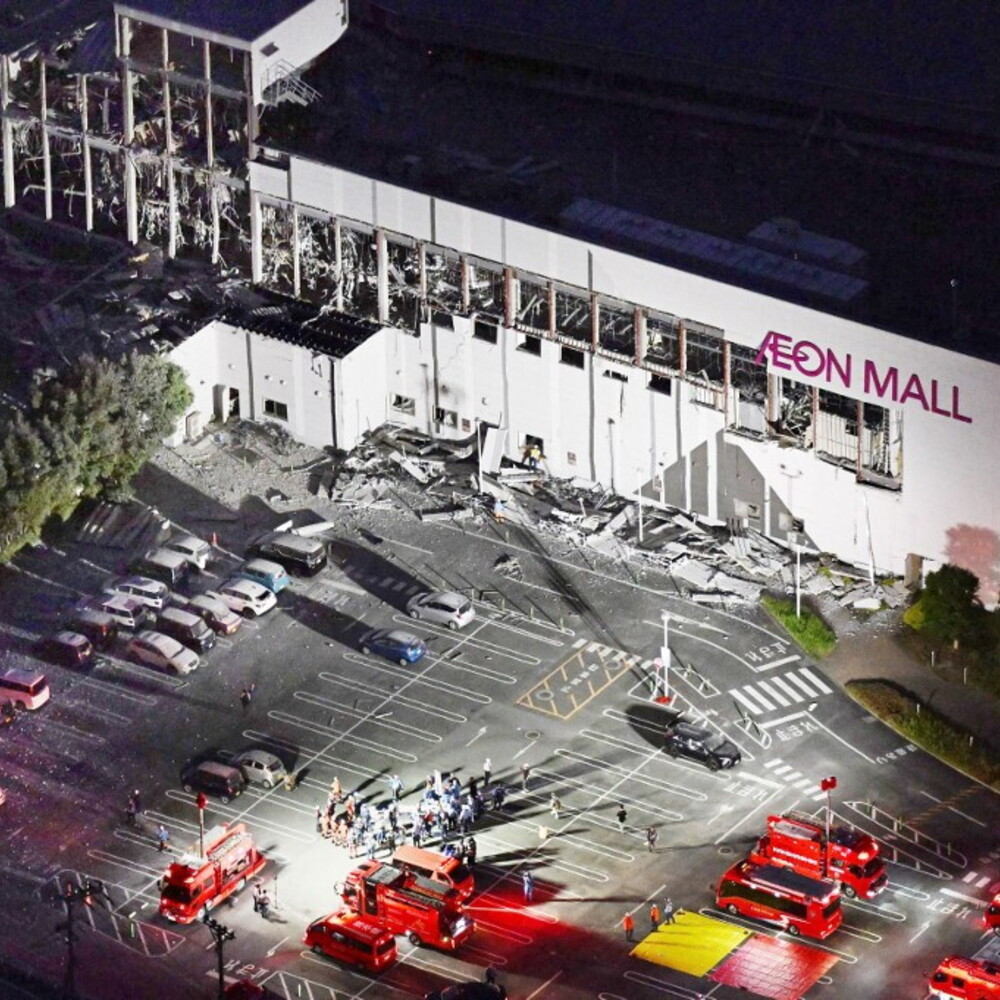
A violent earthquake of magnitude 7.1was registered in Japan southern, near the city of Kumamoto, on the island of Kyushu. There are numerous victims in the collapse of a shopping center, the Aeon Mall in Kashima, TBS television reported.
According to the broadcaster, a “considerable” number of people lost their lives due to the collapse of the second floor, perhaps caused by an explosion. The photos and videos released by NHK show an entire wing of the structure collapsed, with the external walls destroyed. Dozens of employees, between 20 and 30, are currently missing. Immediately after the earthquake, Mall staff helped customers evacuate but it is not clear how many managed to escape before an explosion caused the second floor of the department store to collapse.
In the early hours of the morning (Italian time) theJapanese Prime Minister Sanae Takaichi had declared: “We are still assessing the extent of the injuries and property damage, but I have been informed that there have already been several injuries,” Takaichi said. “Power outages and fires are occurring in some areas, roads and bridges have been damaged and buildings have collapsed,” he further explained.
Some workers missing
One person died in a house collapse. This was reported by the Kyodo news agency. Some workers from a paper mill in the Kumamoto prefecture, the epicenter of the earthquake, are also missing.
The walls of Kumamoto Castle collapse
The earthquake also caused the collapse of part of the walls of the Kumamoto Castle. The Japanese media reported it. It is not the first time that the monument has been damaged by an earthquake: it had already happened in 2016 when a tremor measuring 7.3 degrees on the Richter scale caused the turrets and parts of the fortification to collapse. Long restoration works followed which were not yet completed. Kumamoto Castle is considered one of the three most important in Japan, along with Himeji and Matsumoto.
It was built between 1601 and 1607 by Kato Kiyomasa, a famous feudal lord of the time, who wanted to make it one of the most imposing and difficult fortresses in Japan to conquer thanks to the curved stones of the walls which would allow enemies to climb. And in fact the castle, where the emperor’s troops were barricaded, still resisted for weeks in 1877 the siege of the tens of thousands of rebel troops of Saigo Takamori, ‘the last samurai’, during the Satsuma revolt. After 50 days, the imperial army managed to overcome the rebels and Takamori was killed during the last battle on Mount Shiroyama. With him, the era of the samurai as a military aristocracy ended.
Tsunami warning lifted
The Japan Meteorological Agency has revoked the tsunami warning issued following the earthquake. The alert was removed from the agency’s website just under two hours after the tremor, recorded at 4.27pm local time (9.27am in Italy) on the island of Kyushu.
The quake was recorded at 4.27pm (09.27am in Italy) on the island of Kyushu.
No anomalies at nuclear sites
According to Japan’s Nuclear Regulatory Authority, no immediate anomalies were found at plants in the region. About 45,000 homes and structures are without electricity in Kumamoto Prefecture, according to Kyushu Electric Power, but the three nuclear reactors in the area continue to operate normally. The local electricity supplier, Kyushu Electric Power, said three nuclear reactors operating in the region at the time of the earthquake continued to operate normally.