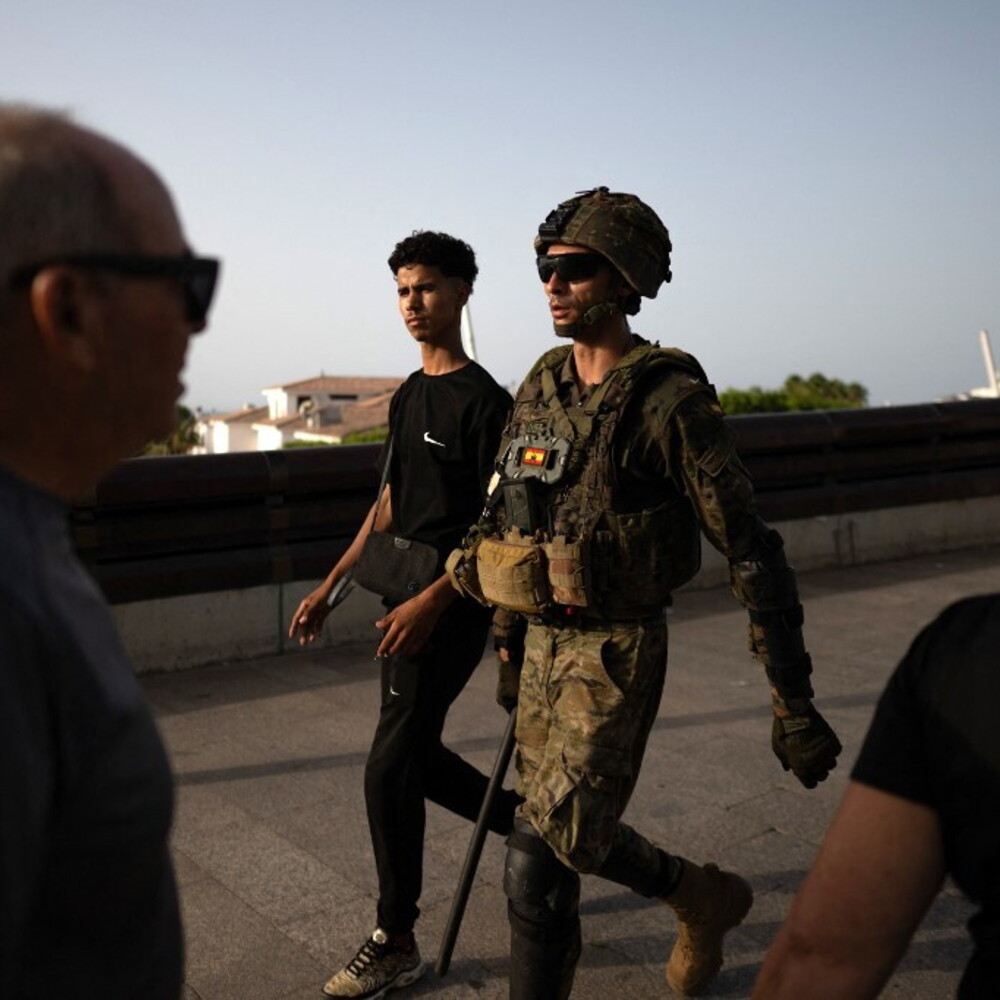
The new migratory pressure recorded on Wednesday in Ceuta, first, and Melilla, (after) brings one of the most delicate fronts in the western Mediterranean back to the center of attention. And if on an immediate level the emergency concerns the management of migratory flows and border control, according to several analysts the crisis is also a reflection of the political and diplomatic tensions that have characterized relations between Rabat and Madrid for decades.
The Western Sahara node
A former Italian United Nations official, serving for many years in the UN mission for Western Sahara (MINURSO), explains to AGI why the current situation “cannot be read exclusively as a migratory phenomenon”.
“Over the years – observes the analyst – Spanish governments, both conservative and socialist, have often favored a pragmatic management of the relationship with Rabat, considered a strategic partner in the security of the western Mediterranean and in the control of irregular immigration, until the passage considered particularly significant with the change in Madrid’s position on Western Sahara. After the US recognition of Moroccan sovereignty over the territory, announced by the Trump administration in December 2020, the government led byPedro Sánchez supported the autonomy plan proposed by Rabat as “the most serious, credible and realistic basis” for a solution to the dispute. A choice that marked a clear discontinuity with traditional Spanish neutrality and which was followed, in subsequent years, by similar openings on the part of other Western partners, including France.
According to the former UN official, this change would have strengthened the Moroccan diplomatic strategy aimed at consolidating international consensus on its claims. “It should however be remembered – he underlines – that the definitive status of Western Sahara remains the subject of an international dispute that is still open within the United Nations and that the Polisario Front continues to claim the right to self-determination of the Saharawi population”.
The current crisis also recalls what happened in 2021, when Spain welcomed the leader of the Polisario Front, Brahim Ghali, for medical treatment, provoking a harsh reaction from Rabat. In those days, in fact, thousands of migrants reached Ceuta, an episode that Madrid interpreted as a consequence of the easing of controls by the Moroccan authorities.
In the current context, there is then the recent resumption of contacts between Madrid and Algiers, also carefully observed in Morocco, since Algeria remains the main international supporter of the Polisario Front and precisely for this reason the relations between Rabat and Algiers continue to be characterized by strong regional tensions.
Rabat’s view on Spanish internal politics
According to the reconstruction proposed by the former UN official, the new migratory pressure could also represent a message aimed at Spanish internal politics. With the next legislative elections on the horizon, “Rabat would therefore carefully follow the evolution of the balance between the Popular Party, the PSOE and the other political forces”. In particular, it is noted that the PP has not formally adopted the Sánchez government’s line on Western Sahara, while a possible future executive could also depend on the support of Vox, a group which for its part maintains very critical positions on immigration and relations with Morocco. In the reading of the former UN official, the events in Ceuta would therefore also represent a political signal addressed to possible future interlocutors in Rabat, so that the current framework of bilateral cooperation is preserved.