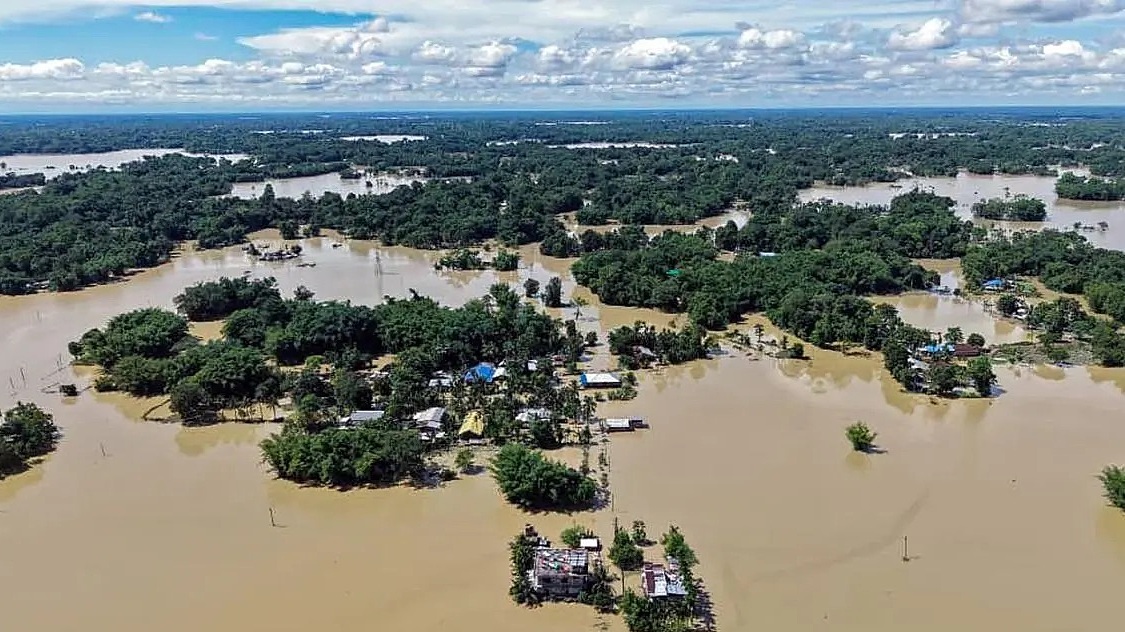
At least 97 people died in severe floods, burying many villages in India’s northeastern state of Assam.
Thousands of people had to evacuate to temporary shelters when rising river water flooded people’s homes and submerged many areas of agricultural land. The flood has inundated more than 14,000 hectares of crops.
Many villages in the state of Assam are buried in mud. According to data released today, at least 97 people have died and about 170,000 people are affected.
In Sivasagar, the district that suffered the most damage, an AFP reporter said many houses were half flooded, trees were uprooted and vehicles were buried under a thick layer of mud.
Many villages were submerged in flood water in Sivasagar, Assam state on July 22. Photo: X/ANI
Chief Minister Himanta Biswa Sarma today posted a video on social media, sending his condolences to the family of a 13-year-old boy who died while trying to save a small dog in floodwaters. “No parent wants to have to say goodbye to their child like that,” he wrote.
Health Minister J.P. Nadda, who visited the heavily affected area on August 6, said it will take a long time for life to return to normal.
“Village after village has been submerged by floodwaters,” he said.
Location of the state of Assam. Graphics: Magnific
Similar to many other areas in India, the state of Assam often suffers from floods during the June-September rainy season, when the country’s largest river, the Brahmaputra, and many tributaries rise and overflow their banks.
However, experts assess that climate change, along with unplanned development, is causing floods to occur more frequently, more intensely and cause more serious damage.
Residents and local officials say illegal coal mining activities in neighboring Nagaland state have made the flooding situation more serious, when many areas that are rarely flooded are now under water. Chief Minister Sarma said he would take up the issue with the federal government.
According to the environmental advocacy organization Climate Trends, floods in Assam state are increasingly serious due to the combined effects of climate change, changes in river flows and an increase in human activities and development in vulnerable areas. This causes floods to occur more frequently, become more complicated and cause greater damage.
RunningAHEAD – Topic: Which online slots and table games pay fastest recently?
Worauf achtet ihr beim Vergleich von Gaming-Plattformen? « Political Science Rumors
Welche Mobilen Casino-Apps Bieten Reale Echtgeldspiele Und Top-Boni?
Innovation Dashboard – Discussion Forum
Wie finde ich vielfältige Echtgeldspiele mit guten Boni? – Auto Forum – autokult.de
Arizona Maxima Group D560 Best Casino Games Reliable Fast Withdrawals Lately.Html
Reviews – Forums 1 | Quincy College
From what I’ve seen recently, players interested in fast wit
Mobile casino apps with best bonuses and fast payouts?
Geknipst – Welche Spielautomaten bieten beste Erfolgschancen und Boni?
Welche Spielautomaten bieten die besten Freispi… | Northwest Fly Fishing Outfitters
F59Bd554 1558 453F A96F 4B1E087Aff72
Welche Spielautomaten lohnen sich wegen täglicher Bonusaktionen am meisten?
How can you choose a reliable online casino and avoid scammers? What should you – Digital Twin Hub
Is it worth playing at new online casinos like The Green Luck, or is it better t
Which Online Casino Bonuses Are Really Worth It: Free Spins or Cashback? We Shar | Radio & Telly UK
I get what you mean, I’ve had that same feeling before. From
Wie findet man seriöse Online-Spieleplattformen und worauf sollte man besonders – NATUR & HEILEN
Ich habe in letzter Zeit ein paar verschiedene Online-Plattf
Seit kurzem achte ich bei der Auswahl von Online-Diensten st
In letzter Zeit achte ich viel mehr darauf, wie sicher eine
Which payment methods are more practical for everyday use: fast digital options or more traditional and stable ones?
How well does the mobile version of Greenluck work in everyday use?
Activity – Karl Hennings – Chameleon Memes
Does a simple interface matter more than having ma