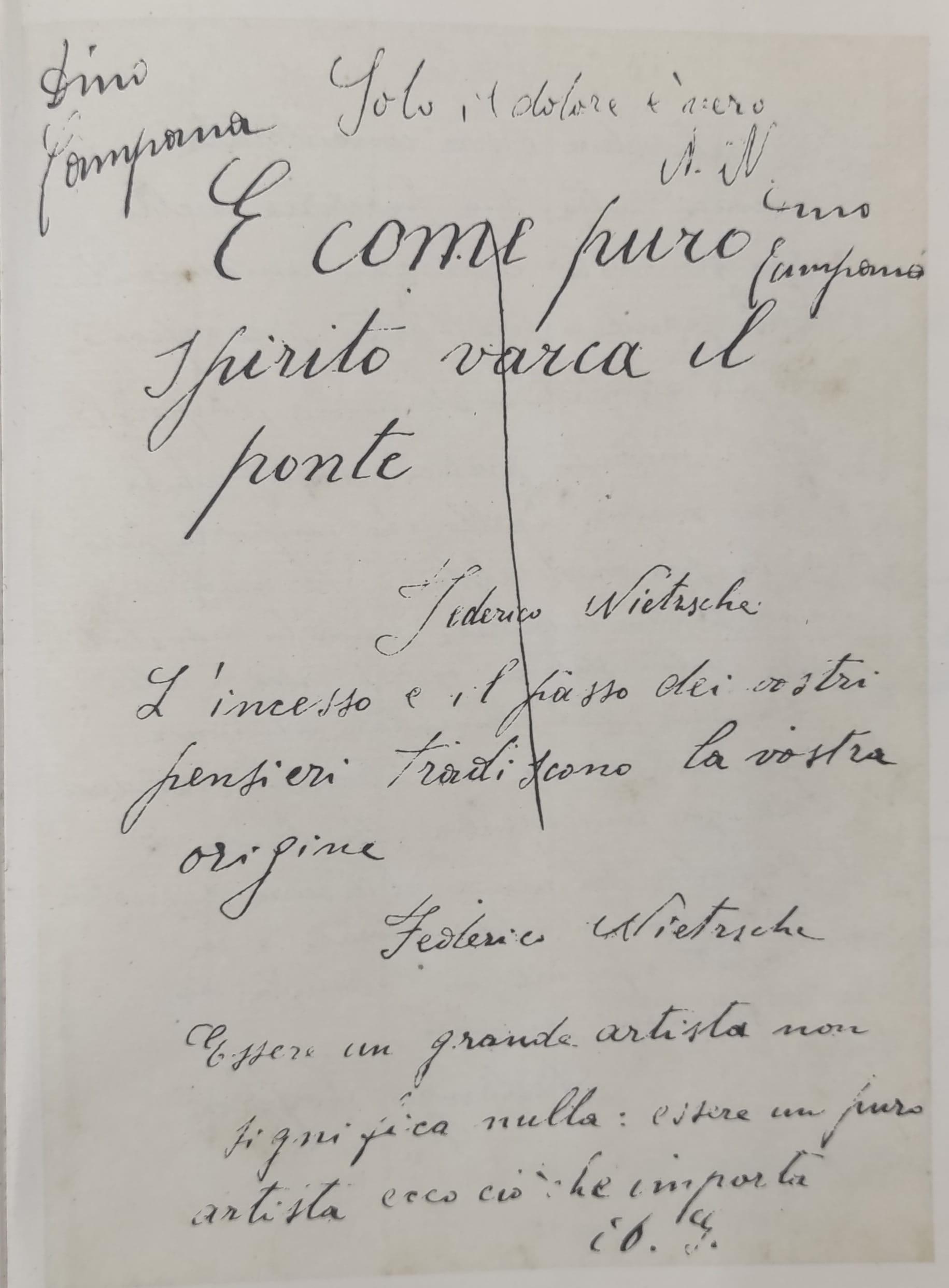
For over a century the disappearance of the manuscript of Dino Campana’s “Più lungo giorno” was described as an accidental loss. Today, new research claims that the painter Ardengo Soffici had found it already in 1927, when the poet was still alive, and that he never returned it to Campana. This is the discovery destined to reopen one of the most controversial cases in Italian literary history, published in the volume “How genius works. The Villon rediscovered and other discoveries on the 140th anniversary of the birth of Dino Campana”, edited by Leonardo Chiari and Walter Scarpi for the Centro Studi Campaniani “Enrico Consolini” of Marradi, forthcoming from the publisher Tempo al Libro.
The new edition collects the developments of the research started after the discovery, announced on 11 May 2025, of the personal example of the Works of François Villon that belonged to Dino Campana. The Parisian edition of 1910, discovered by the researcher Leonardo Chiari, preserves autograph annotations, variants and notes previously unknown, proving to be one of the most important documents for reconstructing the poet’s creative laboratory.
The volume expands the catalog of the exhibition “How genius works”, set up in Marradi in 2025, and collects fourteen unpublished essays dedicated to the most recent discoveries. Among these, according to Walter Scarpi, some “promise to revolutionize consolidated paradigms”. The most significant concerns precisely the fate of the manuscript of the “Più lungo giorno”, delivered by Campana in December 1913 to Ardengo Soffici and Giovanni Papini so that they could facilitate its publication. After the rejection of an editorial proposal limited to some extracts in “Lacerba”, Campana asked for their return in vain. Soffici maintained throughout his life that he had lost the manuscript during a move. The text was published with the original title only in 1973, many years after the painter’s death. The reconstruction proposed in the essay “The end of a mystery”, signed by the researcher Giovanni Cavagnini, however, calls this version into question. During the research resulting in the volume “L’ombra del matto. Mito e memoria di Dino Campana (1932-2025)”, Cavagnini identified a text hitherto ignored by the Italian Campania bibliography: the anthology “Italian Authors of Today”, published in New York in 1938 by Columbia University scholar Peter Michael Riccio. In the chapter dedicated to Campana, Riccio tells of having rummaged, together with other scholars, among the shelves of Soffici’s studio in Poggio a Caiano, coming across the original manuscript they were reading when the painter entered the room. Two details described by the author – a quote from Frirdrich Nietzsche and one from Soffici present on the pages – are absent from the published “Orphic Songs” but appear exclusively in the manuscript of the “Più lungo giorno”. A detail which, according to Cavagnini and Scarpi, makes the document identifiable without misunderstanding.
“From the correspondence between Prezzolini, Papini and Soffici – observes Walter Scarpi – it can be deduced that those meetings with Riccio date back to 1927 and 1933”. If this were the case, the manuscript would have been found at least five years before Campana’s death, disproving the traditional reconstruction according to which it only resurfaced in the 1960s or, officially, in 1971.
Not only that. Riccio also remembers a car trip with Carlo Carrà and Ardengo Soffici near the Castel Pulci mental hospital, where Campana was hospitalized. Carrà proposed going to visit the poet, but Soffici opposed it, claiming that the visit could reopen painful memories. For Scarpi, these elements end up aggravating the moral responsibilities of the painter: “The legend of the lost manuscript must be replaced by the story of a secluded, hidden, retained manuscript”. A reconstruction which, if confirmed, would require updating the poet’s biography and the narrative of the story itself in the school anthologies.
The volume also addresses other central issues of Campania’s work, including the origin of the title “The longest day”, a theme addressed by Stefano Drei, and proposes new documents to understand the genesis of the Canti Orfici. Leonardo Chiari presents in full the autographs found in the Villon, while Gianni Turchetta retraces forty years of studies dedicated to the poet. There is also space for the unpublished degree thesis by Franco Matacotta, full of testimonies collected by Sibilla Aleramo, and contributions by Alberto Petrucciani, Filippo Milani, Luigi Weber, Stefano Fumagalli and Walter Scarpi himself.
On the occasion of the presentation of the volume, today at the Gabinetto Vieusseux headquarters in Florence, the board of directors of the “Marradi Cultura – Dino Campana” Foundation was also announced, established by the Tuscany Region to enhance the figure and work of the poet. It is made up of Riccardo Nencini, historian, writer, president of the Gabinetto Vieusseux of Florence, elected to the presidency, Simone Magherini, professor of Italian literature, and Franco Masotti, cultural operator. (by Paolo Martini)
Slotstars Slots: Top Slot Games at Slotstars
Slotstars Support – Customer Service
Withdraw Your Winnings at Slotstars Casino
Vave Casino: Play Top Games in the UK
Download Vave Casino: Vave Android APK
Vave Mobile App | Download for Android & iOS
Vave Casino Welcome Bonus & Free Spins
Vave Casino: Unbeatable Games Online
How to Deposit on Vave Casino
Download Vave Casino App Instantly
Vave FAQs: How Vave Casino Works
Is Vave Casino Legal in the UK? Find Out Here
Vave Login – Quick & Easy Access to Your Account
Vave Casino Mirror & New URL Access
Play on Mobile with Vave Casino
Payments at Vave Casino: Easy, Fast, Secure
Fix Vave Casino Login & Error Issues
Vave Casino Promo Code: Unlock Exclusive Offers
Vave Casino Review & User Ratings
Best Slots at Vave Casino – Play Top Slot Games
Vave Casino: Contact Support Easily
Withdraw at Vave Casino: Fast and Reliable
Livebet Casino: Premium Online Gaming
Livebet Casino APK: Download for Android Now
Livebet App: Download for Android & iOS Now!