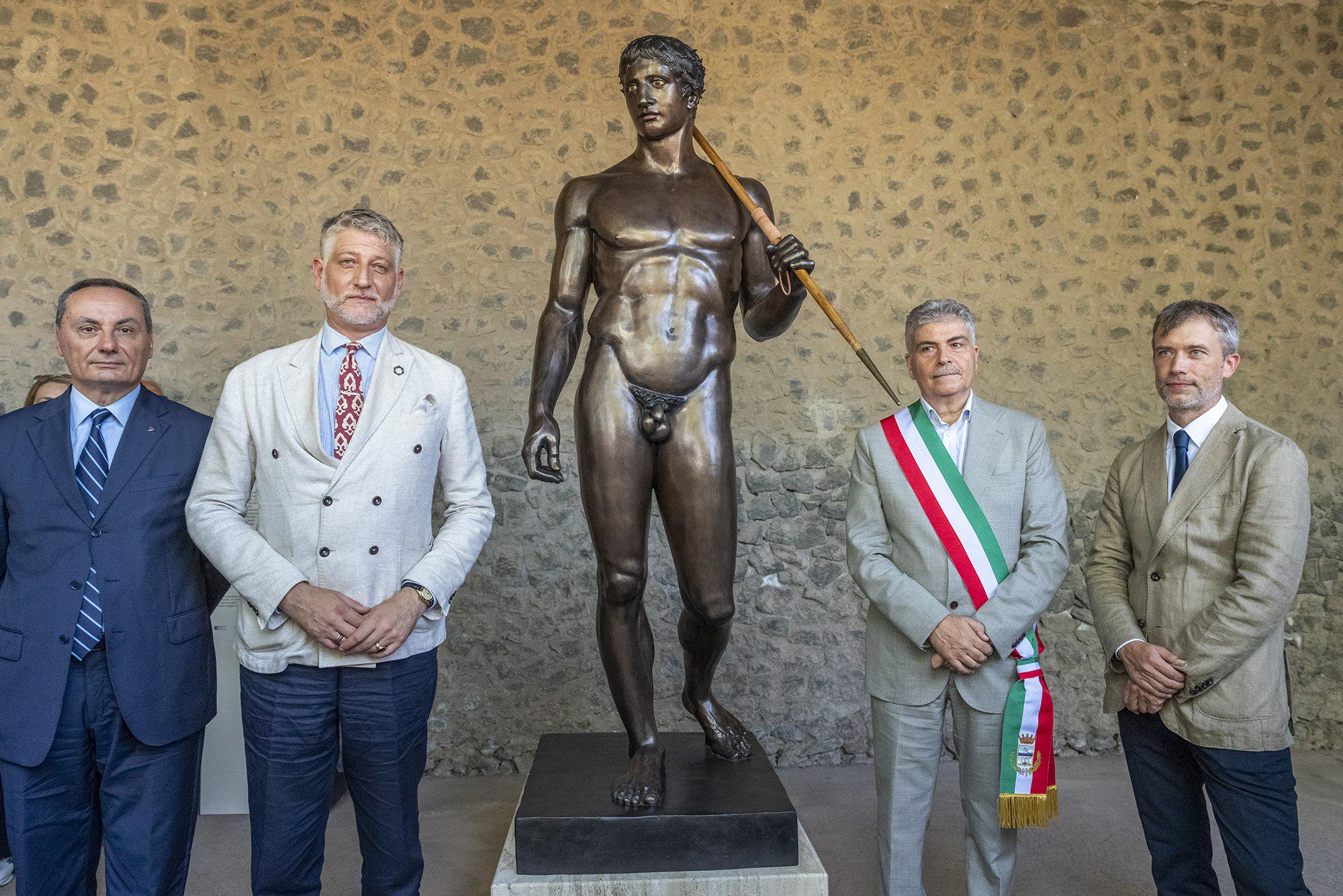
The Canon of Polykleitos comes back to life in Pompeii, one of the most famous masterpieces of ancient Greek sculpture and a universal symbol of the classical ideal of harmony and proportion. The scientific reconstruction in bronze of the work was presented today at the Archaeological Park of Pompeii, created from the historic matrix casts of the former Chiurazzi foundry, a testimony of excellence to the Italian artistic and artisanal tradition. The Minister of Culture, Alessandro Giuli, and the director of the Archaeological Park of Pompeii, Gabriel Zuchtriegel, spoke at the presentation. The public prosecutor at the Court of Torre Annunziata, Nunzio Fragliasso, also took part in the meeting, with a speech dedicated to the topic of protection and enhancement of cultural heritage.
The Archaeological Park of Pompeii brings to life an ancient practice which in the Roman world contributed to the diffusion of the great masterpieces of Greek art: the creation of copies using matrices capable of preserving and passing on their forms. Thus begins the project to valorise the historic matrices of the former Chiurazzi Foundry, acquired by the Park to save them from the risk of dispersion abroad and return them to public use. Inaugurating the route is one of the absolute symbols of classical sculpture, the Canon of Polykleitos, today presented in a new scientific reconstruction made in bronze. The work represents the first concrete result of an initiative that combines protection, research and valorisation, restoring relevance to a unique heritage of models and casts which for over a century have contributed to the diffusion of ancient art throughout the world.
«We are faced with the scientific reconstruction of one of the most famous works of art of all time, whose meaning goes beyond the aesthetic dimension and contains a philological, artistic and cultural value. Polykleitos’ art is founded on the universal language of harmony. This is the teaching that our ancestors, the Pythagorean school and Polykleitos, whose Canon is today returned to the public, handed down to us”, declared the Minister of Culture, Alessandro Giuli, who added: “By supporting projects like this, the Ministry of Culture will continue to carry out its duty. Culture is diplomacy, research, training, plural identity, dialogue and a force that creates harmonies, exactly like the Canon of Polykleitos.”
The Canon of Polykleitos, created around 440 BC. in Greece, it is perhaps the most iconic work of classical art. But the original work is not preserved, as happens with most Greek masterpieces from the classical period, i.e. from the 5th and 4th centuries BC. The great masterpieces of Greek masters, such as Polykleitos and Phidias, are known today mainly through copies from the Roman era. Many of the Roman copies come from Italy, with a concentration in Lazio and Campania, between Baia and the Vesuvian area.
It was precisely from the comparative study of these copies that the discipline that would be defined as “copy criticism” was born. And it is no coincidence that one of the founding moments of this method dates back to the intuition of the scholar Karl Friedrichs, who in 1863 identified Polycletus’s most iconic work in a Roman copy found in the Samnite Gymnasium of Pompeii. On these bases, between 1910 and 1912, the first philological bronze reconstruction of the Greek original was created in Germany, assembling elements from various ancient copies and using the same lost wax casting technique used over 2,500 years ago by Greek sculptors. Today, more than a century after that pioneering operation, the Archaeological Park of Pompeii presents a new reconstruction of the Canon, the result of over a hundred years of studies and international collaboration which involved institutions and scholars in Italy, Greece and Germany. A project that confirms Pompeii not only as a place of conservation of its history, but as a research center capable of contributing to the understanding of the entire legacy of the classical world.
The new reconstruction differs from that of the early twentieth century in two fundamental aspects. The first concerns polychromy: the classical statues were not in fact white as we are used to imagining them, but had colors intended to faithfully reproduce nature, from the hair to the lips, up to the skin tones. The second innovative element concerns the attribute held by the figure. Archaeological investigation suggests that the character was holding a javelin (akontion in Greek) rather than a spear (dory). This interpretation, based on the study of ancient reproductions of the statue, leads us to reconsider the traditional identification of the Canon with the Doryphoros (doryphoros), the famous “spear bearer” of Polykleitos. The ancient sources and the iconographic evidence in fact seem to suggest that they were two distinct works, and not just one, as has long been claimed and as we also read in many school books.
For the new reconstruction of the Canon, two different casts were used: while for the body the marble statue found in 1793 in the Sannitic Palestra of Pompeii was used as a model – the most complete of the over fifty Roman copies known so far -, for the head a bronze bust from the Villa dei Papiri in Herculaneum was used, considered of excellent quality and closer to the original. The javelin held in the statue’s hand was made of wood, leather and metal.
This important result was also made possible thanks to the acquisition, through the exercise of the right of pre-emption, of the collection of the former Chiurazzi foundry, a historic Neapolitan foundry, an extraordinary heritage that the Park is progressively valorising. The history of this reconstruction is thus intertwined with that of the productive rebirth of the collection itself, the first step of a path that today aims at the reactivation of the fusion and marketing activities of the artefacts.
«I asked if a resumption of production, obviously to a limited and controlled extent, could damage the plaster matrices, considering that they represent a protected cultural asset – says the director of the Park, Gabriel Zuchtriegel – but it’s the opposite: they are damaged by not using them, as the plaster becomes pulverized. I find this a beautiful metaphor for our classical heritage, which is destroyed if we do not use it, in schools, in museums and in our cultural life. There are those who consider the classical world dead baggage that can easily be abandoned. We, however, are convinced that the classic is alive and can generate growth, not only cultural, but also economic and social.”
The objective is twofold: on the one hand to expand the Park’s valorisation activities, on the other to support a unique artisan tradition, creating new opportunities for development and employment. In fact, in Naples, foundries still survive that use the same lost wax casting technique practiced at the time of Polykleitos in the 5th century BC, keeping alive a knowledge that combines art, archeology and manufacturing. The reproduction of the ancient statue, thus, was also the occasion of an experimental archeology project to better understand the artistic and productive processes underlying classical art.
«The reason why we chose to begin the valorization of Chiurazzi with this statue is simple – said director Zuchtriegel – We wanted to demonstrate how the knowledge of Greek art of the classical period cannot ignore Roman archaeology, the study of contexts such as the Vesuvian ones which have yielded several copies of the Canon, including one found in the 1970s in Castellammare di Stabia and today in the Minneapolis museum. Beyond any legal consideration, which is the responsibility of the Prosecutor Fragliasso who took over the dossier of the so-called Doryphoros of Stabia, it is a scientific fact: without the contexts, i.e. the houses and public spaces that housed the statues, we do not understand the phenomenon of copies”.