The Prime Minister requested to avoid the situation where cutting this procedure leads to a new one, reducing it at the upper level but arising at the lower level or internally, causing people and businesses to not benefit.
On May 4, Prime Minister Le Minh Hung chaired the regular April Government meeting – the first session of the XVI Government. At the meeting, the Prime Minister asked ministries and localities to continue to reduce and simplify administrative procedures and business conditions.
According to the Prime Minister, if this is implemented quickly and with quality, it will have a great impact on improving the investment environment, mobilizing resources and strengthening the trust of people and businesses in the business environment. He requested that at the beginning of May, the Ministry of Finance and other ministries and branches continue to complete the entire plan, reducing procedures and conditions in the fields of environmental impact assessment, construction licensing, industrial park management, fire prevention and fighting…
Government leaders noted that the Ministry of Justice is responsible for gatekeeping, and local supervision ministries carry out implementation after decentralization. This is to avoid “cutting one procedure and creating another regulation, reducing it at the upper level but arising below or internally, leading to ineffectiveness and people and businesses not benefiting”.
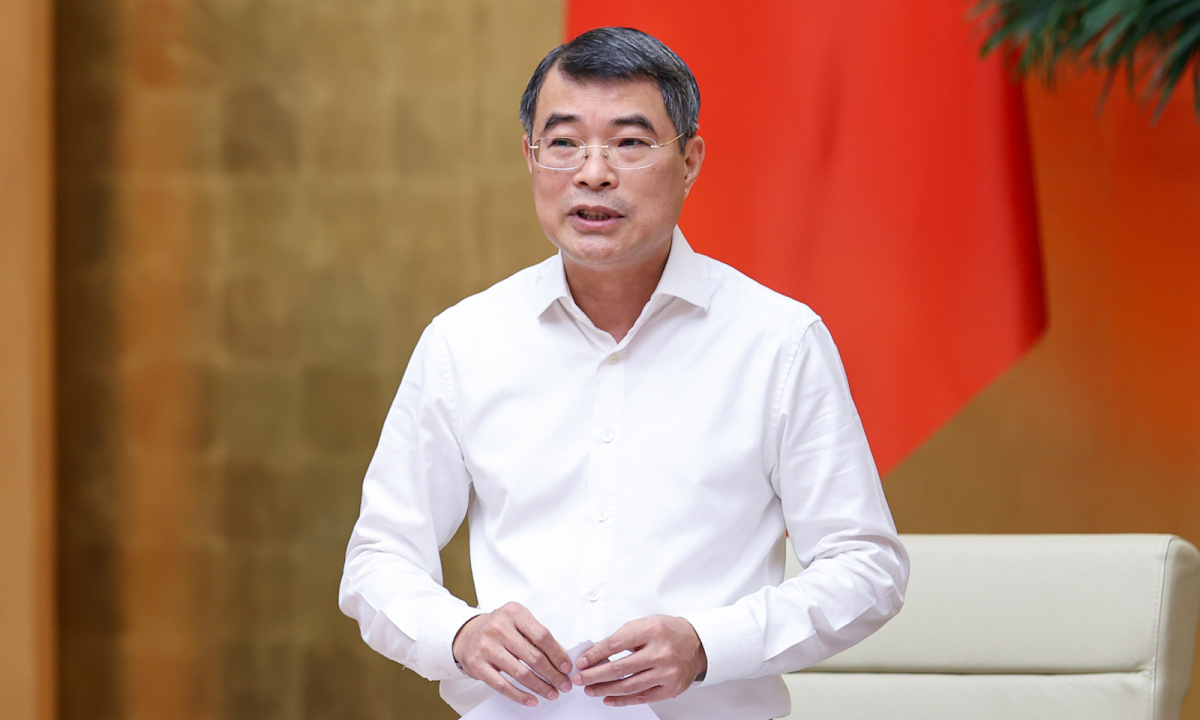
Prime Minister Le Minh Hung chaired the Government meeting on May 4. Image: VGP
In fact, reducing and simplifying business procedures and conditions is considered a key solution to improve the investment environment and promote growth. Compact procedures help businesses reduce costs, shorten time to enter the market, and limit the ask-give mechanism. Thereby, resources are cleared and economic operating efficiency is improved.
At the end of last month, the Government issued 8 Resolutions on reduction, decentralization, and simplification of administrative procedures and business conditions. Authorities abolished 890 business conditions and simplified 4 conditions. The government believes that the implementation process is expected to reduce implementation time and compliance costs for individuals and businesses by more than 50% compared to 2024.
This year, the Government sets a double-digit growth target in the context of great pressure on macroeconomic management, especially on interest rates, exchange rates, inflation, and trade deficit. Prime Minister Le Minh Hung acknowledged that growth in the first quarter has not reached the proposed scenario, traditional growth drivers have not yet fully exploited their potential, and new drivers need time to develop.
Along with that, limitations and inadequacies related to the operation of two-level local governments, administrative procedures, online public services, and national databases also affect macroeconomic management.
In the first four months of the year, the macroeconomy was basically stable, inflation was controlled, and major balances of the economy were guaranteed. The 4-month average consumer price index (CPI) is estimated to increase by 3.99%. State budget revenue is estimated at over 1.11 million billion VND, equal to 44% of the estimate, an increase of 15.2%. Import-export turnover is estimated at 344.2 billion USD, an increase of 24.2%.
Disbursement of public investment capital reached 14.2% of the plan assigned by the Prime Minister, attracting FDI capital increased sharply, newly registered capital reached over 18.2 billion USD, an increase of 32%. Agricultural production remains stable, industry continues to have good development. Production and business showed signs of improvement with over 119,400 businesses registering new establishments and returning to operation, an increase of 32.8%.
To achieve the yearly goal, in addition to reforming procedures and the business environment, the Prime Minister requested relevant ministries to closely monitor the situation, develop scenarios, and respond flexibly and promptly. The Ministry of Finance will soon have a plan to allocate sources to increase revenue, save expenses, and reserve resources to ensure national financial security and safety.
This agency must complete the plan to arrange and equitize state-owned enterprises in May and restructure the operations of the State Capital Investment and Trading Corporation. Groups and corporations completed business targets and accelerated the progress of key projects, especially in the energy sector. Ministries and agencies ensure 100% disbursement of assigned public investment capital, speeding up the progress of handling long backlogged projects.
The Prime Minister assigned the State Bank to flexibly manage interest rates, exchange rates, and credit, supporting people and businesses in accessing capital with appropriate interest rates to serve production, business, priority areas, and growth drivers. They must review regulations to create conditions and ensure liquidity for the banking system, and amend regulations on granting credit beyond the limit for large projects. The banking industry also needs to research and classify types of real estate to set appropriate credit limits and risk coefficients.
The Ministry of Industry and Trade supports businesses to effectively take advantage of 17 signed free trade agreements (FTAs) and promote negotiations for new FTAs to expand markets, while reviewing and supplementing Power Planning VIII, ensuring electricity supply. The Ministry of Construction will soon complete investment preparations, especially the high-speed railway on the North-South axis, the railway connecting with China, and important projects such as Long Thanh and Gia Binh airports.