Ho Chi Minh City organizes its healthcare system into three tiers of care, allowing residents to receive health monitoring, treatment, and rehabilitation right at the local level.
On August 1st, the Director of the Ho Chi Minh City Department of Health, Tang Chi Thuong, stated that the city’s healthcare system development direction is to shift from a model focused on individual hospitals to building a continuous healthcare network centered on the people.
A modern healthcare system is not judged by the number of hospitals or advanced techniques, but by its ability to accompany people throughout their healthcare journey, from disease prevention, early detection, treatment, to rehabilitation and long-term health management, according to the head of the city’s health sector.
After expanding its administrative boundaries, Ho Chi Minh City became a special urban area with over 14 million inhabitants and an area of nearly 6,800 km2. The city boasts the largest healthcare system in the country, comprising 169 hospitals, over 13,000 medical facilities, 168 health stations, and nearly 300 health centers. This scale is both an advantage and a requirement to reorganize the healthcare system towards a unified approach, where each facility assumes a different role but all participate in providing healthcare to the population.
In the context of an aging population, increasing chronic diseases, and a more diverse healthcare need, “Focusing investment solely on the highest level of care is no longer the optimal solution,” Mr. Thuong said.
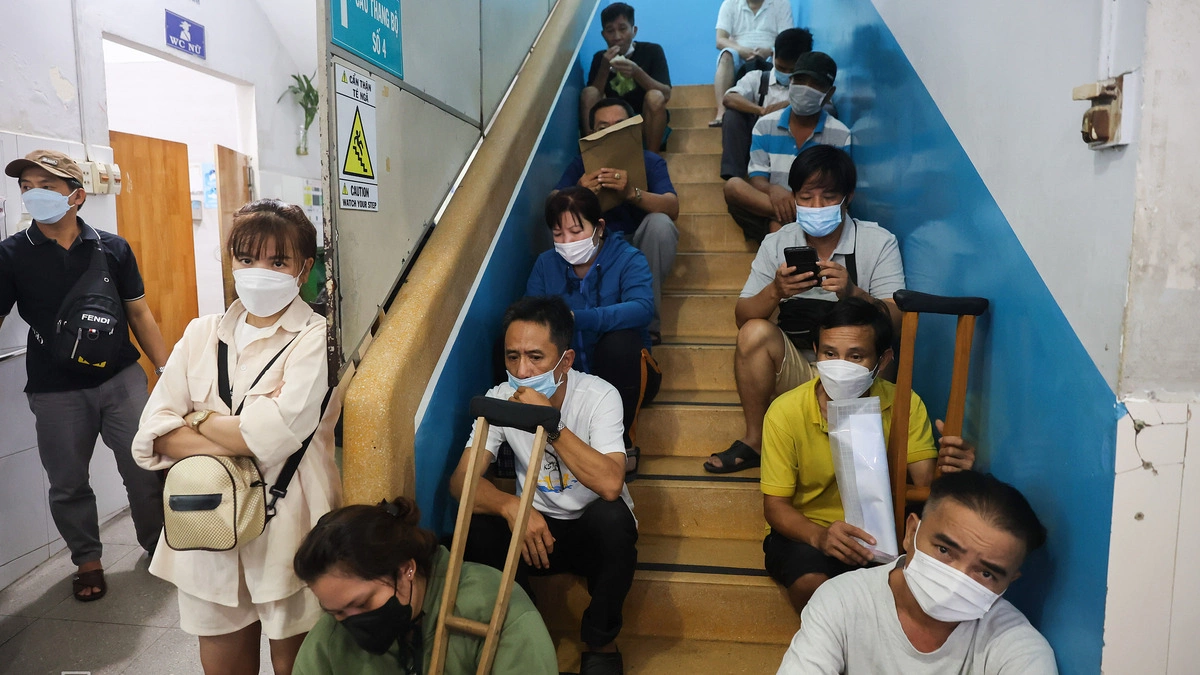
[Image caption: People waiting for examination at a tertiary hospital in Ho Chi Minh City. Photo: Quynh Tran]
According to the new direction, the city’s healthcare system will be organized into three interconnected levels of care. People can receive treatment at various facilities depending on the severity of their illness, but health information, monitoring responsibilities, and care will be maintained throughout.
The first tier is primary healthcare, the most important foundation of the system. This is where people have the earliest and most frequent access to medical services through health centers, family doctors, continuous health care teams, and the community health network.
Previously, the healthcare system mainly waited for people to seek treatment when they were already sick. Now, at this tier, the healthcare sector will proactively manage health throughout the life cycle. People will receive regular health check-ups, vaccinations, risk factor screening, chronic disease management, mental health care, rehabilitation, and follow-up right in the community.
The nationwide health check-up program, electronic health records, and the continuous health care team model that Ho Chi Minh City is implementing are considered important foundations for building a modern primary healthcare tier. The goal is not to treat more diseases, but to help people stay healthy longer, detect diseases earlier, and reduce the number of hospitalizations.
People needing treatment will be transferred to the primary healthcare level, centered around regional general hospitals, gateway hospitals, and general hospitals. This level is responsible for addressing the majority of healthcare needs, from routine emergencies, internal medicine, surgery, obstetrics, pediatrics, to rehabilitation and common medical procedures.
According to Mr. Thuong, investing in regional hospitals not only aims to reduce the burden on higher-level hospitals but also helps people access high-quality services closer to their homes. Developing gateway hospitals in Thu Duc, Cu Chi, and Hoc Mon, along with improving the capacity of regional hospitals in Binh Duong, Ba Ria, and Vung Tau after their expansion, will create a strong enough network to address most local healthcare needs.
“An effective healthcare system is not one that has many people being transferred to higher-level hospitals, but one that best addresses healthcare needs at the primary level,” Mr. Thuong said.
Complex or highly technical cases will be transferred to the specialized treatment level, which houses the city’s top-tier specialized and general hospitals. However, the role of the specialized level is not limited to treating difficult cases. It also serves as a center for scientific research, development of new techniques, personnel training, technology transfer, remote consultations, and professional support for the entire healthcare network.
After treatment, patients will be transferred back to the basic treatment or primary care level to continue rehabilitation and long-term health management.
[Image caption: High-tech treatment at a top-tier hospital in Ho Chi Minh City. Photo: Quynh Tran]
According to Mr. Thuong, the biggest difference of this model is the connection between the different levels of care. Each citizen has only one healthcare journey but can go through many different medical facilities. The important thing is not where treatment takes place, but that all facilities participate in patient care based on data sharing, professional coordination, and continuous monitoring.
Electronic health records, electronic medical records, referral systems, pre-hospital emergency care, teleconsultation, and digital platforms will be tools connecting the three tiers of care into a unified system.