The National Digital Transformation Agency said that the 4-layer architecture including infrastructure, data and core platform is being applied in communes and wards, helping to promote digital government and digital economy.
At the training workshop “Implementing the digital transformation model at commune and ward levels” held on the afternoon of June 4, organized within the framework of the Vietnam Digital National Forum 2026 (Digifest 2026), Mr. Hoang Huu Hanh, Deputy Director of the National Digital Transformation Department, said that the commune-level digital transformation model has been issued by the Ministry of Science and Technology, as a basis for uniform implementation nationwide.
The model was issued at the end of April to guide communes and wards to uniformly digitally convert nationwide, in sync with the reference digital architecture framework at commune, provincial and overall national digital levels.
Accordingly, the model defines an architecture consisting of 4 layers (infrastructure, data and core platform, applications and operations, interaction channels and performance measurement) and 2 cross-cutting components (operations – administration and resources – human resources). Commune and ward levels are encouraged to use shared infrastructure and platforms at the provincial and national levels and proactively update data, deploy applications and solutions and directly provide digital services to people.
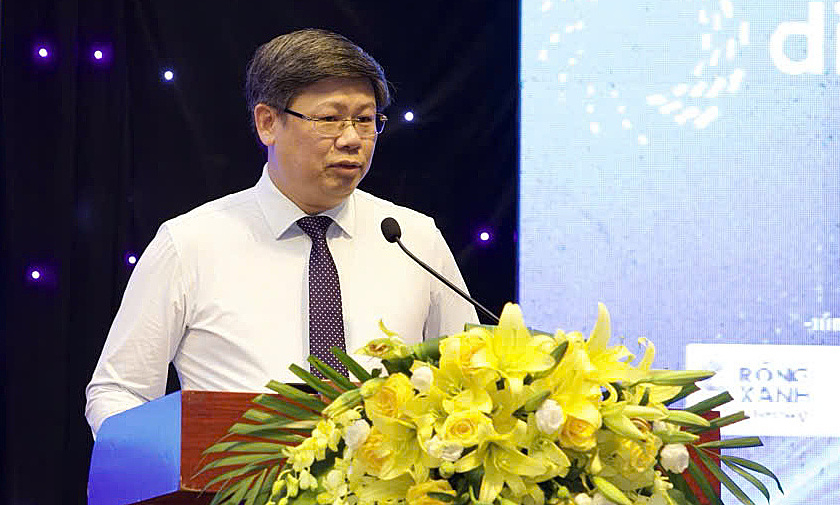
Mr. Hoang Huu Hanh, Deputy Director of the National Digital Transformation Department, spoke at the training session on the afternoon of June 4. Image: Digifest
Sharing experience from actual implementation, Mr. Nguyen Duy Khiem, Chairman of Yen Binh Commune People’s Committee, said that the entire system from the Party Committee, People’s Council, People’s Committee to the villages is connected in the digital environment. The digital village management platform is used to assign work, track tasks, exchange work and operate throughout the commune to the village.
100% of key tasks and 100% of Yen Binh’s socio-economic development targets are tracked in the digital environment. Areas such as public investment, budget revenue, budget revenue targets, growth rate, and public investment disbursement are all managed on digital platforms and assigned targets to each specialist.
Through the model, people can access information, policies and government services more conveniently.
Applied in the field of education, 100% of schools in Yen Binh area have implemented digital management and digital learning.
In agriculture, Yen Binh is building a smart agricultural operation center, digitizing data on growing areas, diseases, markets and agricultural management activities. The locality has created a database for 4,238 of the total 7,600 hectares of planted forests, equivalent to 55.7% of the area, and has an application to manage planted forest codes and trace legal wood origins.
Discussion session at the training workshop on implementing the commune-level digital transformation model within the framework of Digifest 2026. Photo: Digifest
In Phu Lien ward, Hai Phong city, Mr. Tran Quang Hung, Vice Chairman of the People’s Committee, said that to build an operating system, the ward started from building a database with more than 250 management data frames, more than 36,000 information fields, more than 56,000 residential accounts, 6,000 households. Data is integrated from many blocks such as the Party, People’s Committee, Fatherland Front, and public service units.
Up to now, the ward’s e-Gov DSS operating system allows visual monitoring of tasks, budget revenue and expenditure targets, public investment disbursement, project implementation progress, social security and monitoring the reception and handling of people’s feedback and recommendations.
Phu Lien ward’s report said that digital transformation is deployed synchronously in the entire process of handling administrative procedures, shortening processing time, reducing the amount of paperwork and costs for people and businesses. The rate of online applications in the ward reached over 98%. Each month, the virtual assistant receives about 30,000 questions from people.
Opinions at the training session also assessed that building a digital transformation model at commune and ward levels is considered one of the important foundations to realize the goal of building a digital government, with people at the center.
Mr. Hanh said that each effective model at the facility will be synthesized, evaluated and replicated nationwide by the Department of Digital Transformation.