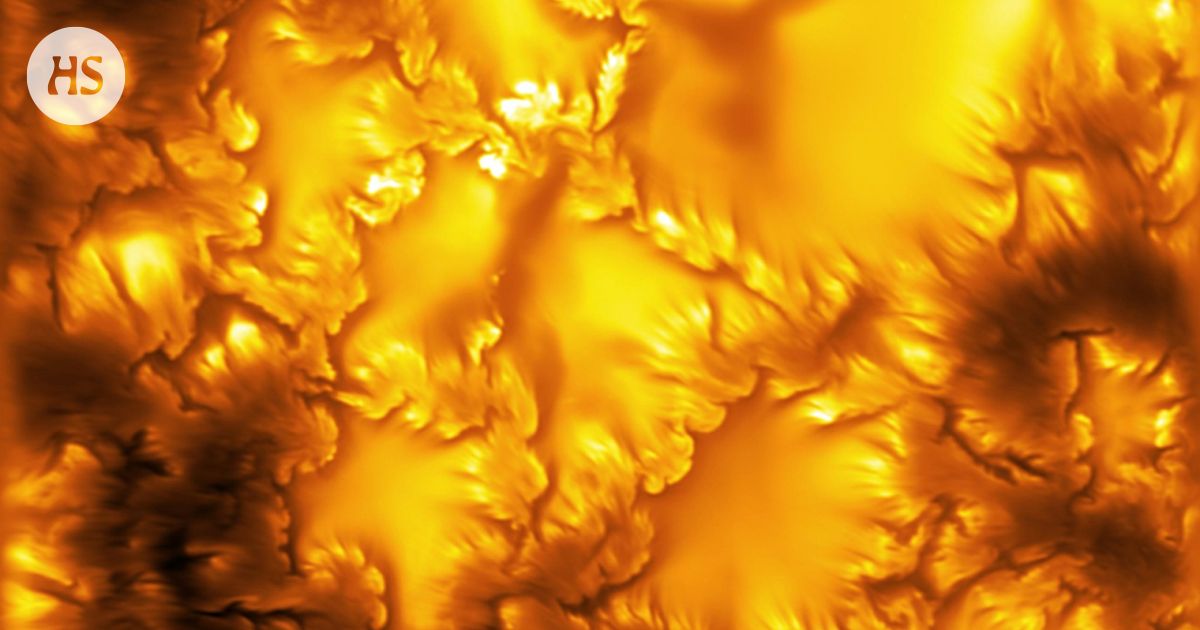
This has not been seen before. Plasma swirls on the visible surface of the Sun.
The most accurate pictures ever taken of the Sun were published on Wednesday in the scientific journal Nature.
“Really great pictures. It’s amazing how precisely you’ve been able to see,” comments the Finnish solar researcher, professor of space physics Emilia Kilpua.
The time lapse video zooms in on a small area near sunspots and eventually reveals structures only twenty kilometers in size.
The surface of the sun bubbles first like a pot of porridge. Then you can see the turbulence of the eddies in the close-ups.
Pictures took the American Daniel K. Inouye solar telescope, the most powerful of its kind in the world. The telescope is located on the island of Maui in Hawaii.
Events in the surface layer of the Sun can be seen because the density of the plasma in the photosphere of the surface thins so that light can escape. The sun does not have an actual solid surface.
It has already been possible to interpret from earlier less accurate images that in the bright centers of the cells visible in the images, hot plasma rises from the deeper layers of the Sun and cools down again at the dark edges.
Now you can also clearly see the swirling of the plasma when it meets the currents traveling at different speeds. The observation is the first evidence of the so-called Kevin-Helmholtz mechanism in the Sun.
Vertical currents travel to the surface of the Sun, where hot plasma rises from the deeper layers of the Sun and cools down again.
Spinning can partially explain why the Sun’s upper gas ring gets extremely hot and why the surface magnetism changes and migrates, says the group of researchers who analyzed the image series In Nature.
According to Kilpua, the same vortex mechanism has been observed in clouds and ocean waves, as well as when particles erupting from the Sun hit the Earth’s magnetosphere.