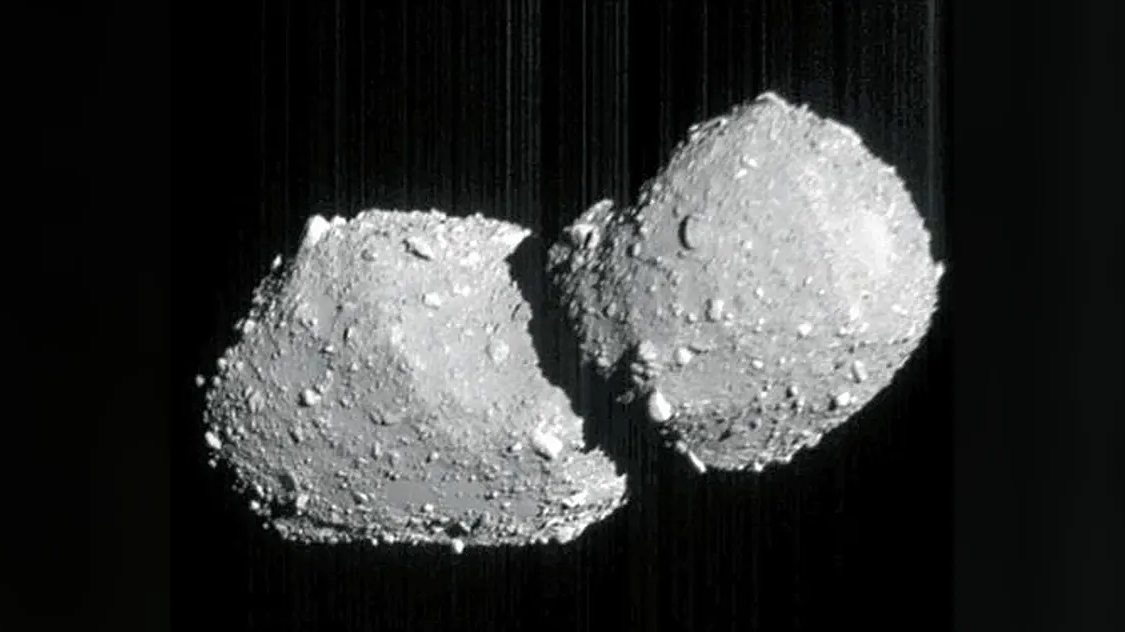
The Hayabusa2 ship, as large as a refrigerator, came within just 400 meters of the Torifune asteroid during a mission to fly close to this celestial body.
The Japan Aerospace Exploration Agency (JAXA) said this week that Hayabusa2 on July 5 moved at a speed of more than 18,000 km/h, to the surface of the Torifune asteroid. 400 m and 744 m from the center of this celestial body, closer than the 800 m mark as previously predicted by JAXA.
“The results show that, compared to every space probe in the world that has ever performed a flyby mission, Hayabusa2 comes closest to the asteroid,” JAXA scientist Yuya Mimasu announced.
According to Nikkei, the previous record was set by a Chinese spacecraft when it flew 770 m from the surface of an asteroid.
The close flight to Torifune took place when the asteroid was about 100 million km from Earth. According to AFP, after the flight, JAXA released a series of photos taken from the camera on Hayabusa2, showing that Torifune looks like a snowman with two circular rocks connected together. Previously, it was known to have an elongated shape, but scientists did not know its detailed structure.
Photo of asteroid Torifune from the camera of Hayabusa2 on July 5. Photo: JAXA
Hayabusa2 launched into space in 2014, flew to the asteroid Ryugu, then landed and collected samples. At the end of 2020, the ship flew back and dropped a capsule containing valuable samples to Earth, providing scientists with clues about the solar system when it was first formed about 4.6 billion years ago.
According to Space, Hayabusa2 did not “retire” but continued to carry out its extended mission. After studying Torifune, the spacecraft will arrive at 1998 KY26, an asteroid orbiting the Sun with an orbit between Earth and Mars. This asteroid completes one orbit in 1.37 years, occasionally crossing Earth’s orbit. It has a diameter of about 30 m and rotates very quickly, only about 10.7 minutes to rotate once around its axis.
Asteroids are valuable tools to help astronomers understand the early Solar System. Many scientists believe the building blocks of life on Earth originated from meteorites from elsewhere. Therefore, studying the composition of asteroids can help people understand more about how life appeared on Earth, and even search for places where life is likely to exist.
In addition, Ryugu, Torifune and 1998 KY26 all belong to the near-Earth asteroid group. Studying them can help scientists prepare for the risk of collisions between Earth and similar objects, thereby better protecting the blue planet.