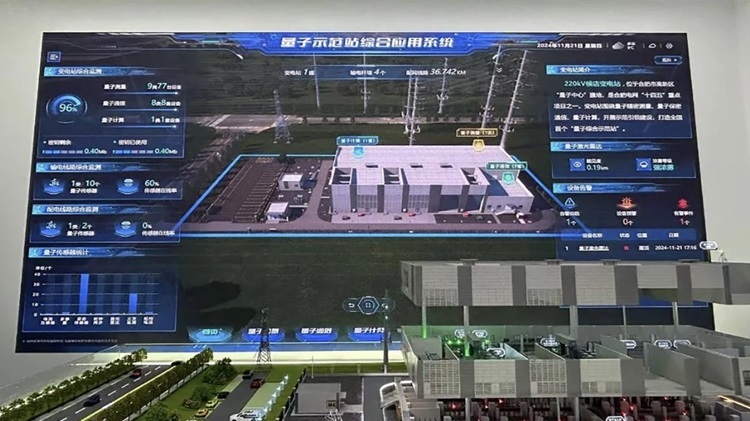
Chinese researchers are applying quantum technology to monitor power grid activity, thereby quickly detecting and fixing errors before power outages occur.
Theo SCMP, quantum technology including precision sensors and computer simulations was tested over an 18-month period at a substation in Hefei, Anhui province, helping to quickly detect and diagnose faults and problems in the power system.
Coming into operation in November 2024, the project at the substation in Hefei develops and applies dozens of quantum solutions spanning three areas: measurement, communication and calculation.
In the substation’s switchgear room, where high-voltage electricity is distributed through the system, a specialized quantum sensor monitors minute changes in temperature and humidity in real time. In particular, it is capable of detecting partial discharges, a common fault that can damage equipment and cause power outages. Engineers also use other types of quantum sensors to monitor the amount of electricity flowing through the lines and quickly locate faults. Quantum technology is also applied to detect cracks in materials such as iron and cobalt as well as the risk of fire and explosion.
The transformer station in Hefei applies dozens of quantum solutions from 2024. Photo: Xinhua
In addition to operational monitoring, the substation integrates quantum encryption devices into the fiber optic lines of the power system and 5G network to help increase safety. The facility uses Origin Wukong, China’s third-generation superconducting quantum computer, which models the potential operating states of the power grid.
According to Tian Teng, a researcher at Anhui Provincial Electric Power Company, this breakthrough will help enhance the real-time analysis and computing capabilities of the power system, overcoming several problems such as inaccurate and delayed equipment monitoring, weak data security and sluggish computing.
For example, traditional transformer stations often encounter discrepancies between the actual amount of electricity transmitted or consumed and the parameters on the measuring equipment. To solve the problem, researchers developed diamond-based precision quantum measurement technology, capable of sensing small fluctuations in electrical current. It is estimated that this technology allows the substation to reduce power measurement errors by more than 500,000 kilowatt-hours per year, significantly improving reliability and performance. The research team is continuing to innovate and develop new quantum applications such as tools to detect gas leaks due to equipment failures.
In addition to quantum technology, Chinese authorities also introduced a new AI system that helps solve problems in the power grid in 3 seconds instead of 6-10 hours as before. Theo Interesting Engineering, AI in the power grid collects large amounts of data from a variety of sensors to improve the ability to troubleshoot power outages. This system can automatically select the most efficient and feasible power supply routes without human intervention. If any problem occurs, the AI system is designed to immediately activate self-healing functions, including automatically locating the fault, isolating the faulty part and restoring power.
When a power outage occurs, the grid management computer often generates a large number of error codes. The operator then has to spend a lot of time researching these codes to find a solution to fix the power outage problem. Meanwhile, AI relies on natural language processing to make this process much faster.
Data collected from the pilot project is used by authorities at higher level substations. China is currently planning to expand the application across the entire national power grid to prevent power outages.