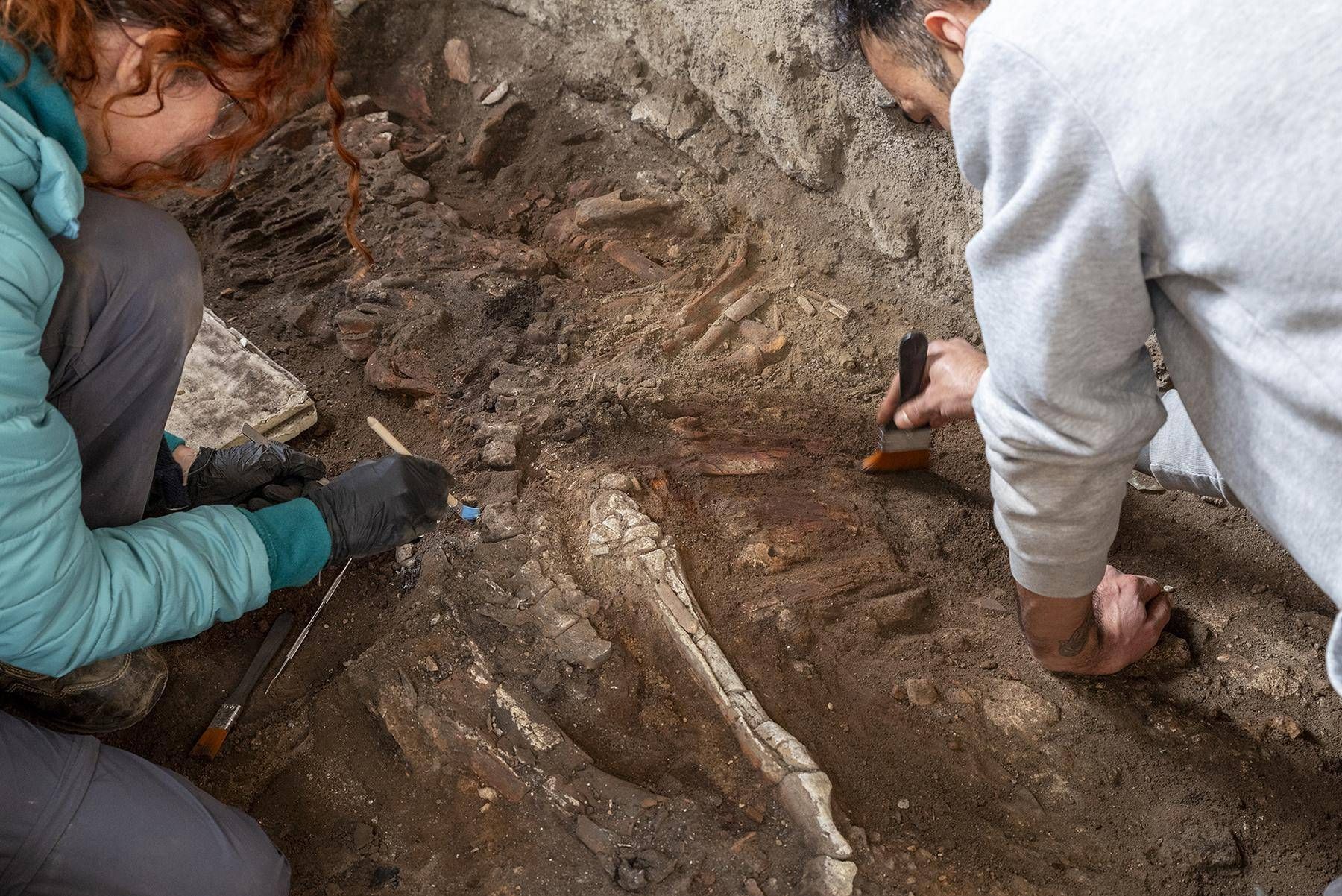
Not just men and women, not just frescoes. Almost two thousand years after the eruption of Vesuvius which obliterated Pompeii in 79 AD, a new discovery gives voice back to one of the most silent protagonists of Roman daily life: an equid, probably a horse or a donkey, whose skeleton was found during excavations in the famous complex of the Casti Amanti. The discovery took place inside an environment intended for bread processing, in the heart of one of the most important archaeological sites of the ancient city. Here archaeologists are bringing to light an entire perfectly preserved production structure: oven, warehouses, work areas and even the owner’s home, offering an extraordinary insight into the economic and social life of Pompeii shortly before the catastrophe.
The animal discovered is not an isolated case. In the large bakery attached to the domus, other equids used to operate the millstones and transport the grain necessary for the production of bread had already been found in the past. This new specimen, however, tells a different story. According to the scholars’ initial hypotheses, he may have moved away from the stable during the excited phases of the eruption, finding his death in an environment different from the one in which he normally lived and worked. The discovery – published in the digital magazine E-journal of the Pompeii Excavations – is the result of an investigation conducted in close collaboration between archaeologists and specialists from the Applied Research Laboratory of the Archaeological Park of Pompeii, involving archaeozoologists, archaeobotanists and anthropologists. At the moment, scholars are cautiously speaking of equids because from the first analyzes it is not yet certain whether it is a horse, a donkey or another animal of the same family.
The Insula dei Casti Amanti, explains the director of the archaeological park, Gabriel Zuchtriegel, is one of the most important construction sites in Pompeii because it preserves an entire production structure with oven, warehouses, processing spaces, as well as the owner’s home. The complex, famous for the fresco of the “chaste kiss” found in a triclinium of the residence and which gives its name to the entire block, includes a large bakery with attached stables, where in the past other equids had already been found used to operate the millstones and transport the grain necessary for the production of bread. The excavation represented the first phase of the investigation, which was followed by the first studies on the materials found. The laboratory analyses, still in progress, will allow the collection of further data both on the function of the animal within the production context and on the conditions in which it found itself at the time of the eruption of 79 AD. The study of the equid will also contribute to the understanding of the eruptive dynamics and the reactions of the animals to the catastrophic events that hit the city, adding a further piece to the reconstruction of those dramatic hours. “It is the demonstration of how Pompeii offers an extraordinarily preserved context, which allows us to investigate ancient life in a systemic way, reconstructing the relationships between spaces, productive activities, individuals and animals”, underlines Zuchtriegel in a statement. The research continues between study of the finds and laboratory investigations, in a continuous dialogue between different disciplines, to give voice to even the most silent remains and remember how every testimony – human or animal – holds a story still to be brought to light.
“Pompeii for a long time – declares the director Gabriel Zuchtriegel – represented above all the beauty of the frescoes, the possibility of studying the material culture of antiquity. In reality it is much more: it is the possibility of knowing the human lives that were broken during the eruption, as in the recent exhibition of the casts of the victims here in Pompeii, but also the lives of animals. In this case of an equid, a horse or a donkey, which was found inside a House containing beautiful frescoes, the House of the Chaste Lovers. The Domus also served as a bakery and a mill. In the past, several animals were found. But recently, as part of new excavations, another animal was discovered, which had escaped and was in another environment The excavation of this equid in the Casti Amanti complex is also an excellent example of the multidisciplinary work that takes place on the site every day: archaeologists and specialists from different disciplines who collaborate to reconstruct not only the objects, but the relationships between people, animals and production spaces. The analyzes are still ongoing and will give us further information: the site continues to offer material of great scientific value”. (by Paolo Martini)